The Annapurna Base Camp with Mardi Himal Trek is a traditional 12-day trek that circles the renowned southern Annapurna Base Camp and Mardi Himal route in the Annapurna Region. With a starter package costing USD 670 per person, the trip is customizable to travelers' preferences without cuts to the services provided.


Annapurna Base Camp and Mardi Himal Trek - 11 Days
Duration
12 Days
Trip Grade
Medium Hard
Maximum Altitude
4500m
Group Size
Min 2 Persons
Activities
Trekking
Starts
Pokhara
Ends
Pokhara
Best Time
Mar-May, Sep-Nov
Introduction to Annapurna Base Camp with Mardi Himal Trek
The Annapurna Region is home to many, among which lies the renowned route that encircles the southern base camp of Annapurna and the flower-covered path of the Mardi. Protected and conserved under the laws of the Annapurna Conservation Area Project, the region shelters a diverse, multiethnic population of Nepal, especially the tribal people of the hills. Along with human culture, the region is home to diverse plant, animal, and bird species. The conservation is a legal parent conserving the region’s natural beauty and preserving the diversity of life there.
The trekking route from the southern base camp of the Annapurna to Mardi Himal is a unique trekking route that combines the alpine trails of the Annapurna through rock spires and glaciers with the traditional and alpine mixed route of Mardi. The route emphasizes the exceptional cultural and landscape experience of different regions of the Himalayas. From the breathtaking view of the Annapurna Ranges at Mardi viewpoint to the very peaks within the reach from the base camp of Annapurna South, it carries unforgettable memories from both geographical and cultural experiences.
What makes the trek unforgettable – Highlight of the trek
The beauty of the Annapurna Base Camp, combined with the Mardi Himal trek, is not bound to a specific location or scenery; the whole route that encircles the glacier valley of Annapurna and the alpine meadows of the Mardi with mixed cultural experiences of local communities highlights the trek's true hidden beauties. Re-creating the traditional route used by the local shepherds, the trek shows a contrasting difference. Individually, the southern Annapurna base camp features indomitable peaks, strengthening the spirits of every traveler passing through the rock spires and glaciers, while the route to Mardi features a calm and peaceful walk through dense forests of hills to high grasslands filled with seasonal flowers, combining the both transitioning route that Annapurna Base Camp mixed with Mardi Himal route itself is the main highlight of the trek.
The route is not chained merely to trails or paths that are walked upon; the encounters along the way make the route unique. The trek highlights the gradient transition of vegetation, culture, and life itself. The route is not only a path to the great Himalayan scenery but also carries the centuries-old history of rural Nepal, the local shepherds' daily struggles, villagers' stories, and wildlife that can’t be wrapped in a few words. Let’s have a highlight breakdown of the Annapurna Base Camp with the Mardi Himal Trek.
Cultural Highlights (Annapurna Base Camp & Mardi Himal)
- Traditional Gurung villages with a strong community-based mountain lifestyle.
- Presence of Magar communities in the lower hills with mixed Hindu traditions.
- Blend of Hindu and Buddhist practices along the trekking route.
- Ancient monasteries, prayer flags, and local spiritual landmarks.
- Warm hospitality with authentic local food and teahouse culture.
Landscape & Scenic Highlights
- Lush rhododendron and bamboo forests in lower regions.
- Terraced farmlands and river valleys in the foothills.
- High alpine landscapes at Annapurna Base Camp (4,130 m).
- Panoramic ridge walks on Mardi Himal with open mountain views.
- Close-up views of Annapurna, Machhapuchhre (Fishtail), and Hiunchuli.
Wildlife & Flora Highlights
- Rhododendron forests bloom in the spring season.
- Oak, pine, and bamboo vegetation across the mid-hills.
- Alpine shrubs and sparse high-altitude vegetation.
- Medicinal herbs found in the Himalayan regions.
- Himalayan Monal (Danphe), Nepal’s national bird.
- Himalayan Thar grazing on steep rocky slopes.
- Musk Deer in forested sections.
- Langur monkeys in lower and mid-altitude forests.
- Variety of high-altitude birds and pheasants.
- Rare sightings of species like Snow Leopard (upper regions).
Unique Route & Experience of ABC & Mardi
- Combines classic Annapurna Base Camp trail with off-the-beaten Mardi Himal route.
- Experience both alpine glacier basin (ABC) and ridge-line trekking (Mardi Himal).
- Less crowded Mardi trails compared to the busy ABC route.
- Gradual transition from dense forests to open Himalayan ridges.
- Diverse trekking experience within a shorter combined itinerary.
The Annapurna Base Camp with Mardi Himal Trek offers a unique blend of cultural diversity, scenic landscapes, rich wildlife, and a combination of alpine base camp trails with panoramic ridge walks, making it one of the most diverse trekking experiences in Nepal.
Trekking the Annapurna Base Camp with Mardi Himal in 2026/27
The Annapurna Base Camp is known for its spectacular view of the Machhapuchre and the Annapurna South, which can be seen within reach of a palm. From dense valleys to the glacial valley trail, the trek is still popular among all generations of Trekkers. Combined with the alpine ridge trails of Mardi, accessed through the floral forest of hills, the trekking route gives meaning to how adventure should be. The trek was known for its rurality mixed with the untouched pure beauty of nature. So, how is the trek in current years?
With time, even nature changes its course, but the Annapurna Valley still retains the incomparable beauty of the Himalayas, despite significant changes in tourism. The beauty of the trek now accommodates luxury with rurality. How?
Due to the growing popularity of the region, locals and the government contributed to providing more comfortable lodges and food for both domestic and international trekkers. Compared to facilities post-condition, the current Annapurna region, including Mardi, accommodates more luxury stays with a variety of food and beverage options.. The trails are beginner-friendly, with multiple signposts and markers for easy navigation, and, due to growing visitor numbers, the route is well-managed by both local communities and conservation. If the trek is on your bucket list, find a suitable date and book your next trip with us.
Best time to visit Annapurna and Mardi – Seasonal Breakdown
In general, Nepal experiences peak travel time twice a year. The season falls in Spring (Pre-monsoon) and Autumn (Post-monsoon). Both seasons are widely popular for adventure activities in Nepal, especially trekking in the high passes. On average, the peak season lasts for 5-6 months a year with an equal gap between seasons. Now, why are these particular seasons considered the best time to visit the Himalayas?
The spring season (March-May) is known as the season of flowers and new life. After a harsh winter, the vegetation starts anew, adding a colorful scenery to the cold and dry Himalayas. Which is the perfect time to visit places like Mardi Himal? Since Mardi is not only known for breathtaking close views of the Annapurna South, Mt. Fishtail, and Mardi, but also the colorful path from lower camo filled with seasonal flowers, which you can check out in the gallery section. Personally, spring is recommended due to its mixed trail of greenery and alpine trails. So, spring is your go-to season for experiencing calming, peaceful trails and enjoying passive activities like birdwatching.
The Autumn season (September-November) is the favored season for high passes and a seamless view of the whole Annapurna Range. The months from September to November fall after a long rainy season, sweeping away clouds and possible pollution. Major festivals of Nepal coincide, making it a perfect time for those who seek cultural experiences with clear mountain views.
Seasonal Breakdown
Spring (March–May)
- Warm days, stable trekking weather
- Blooming rhododendron forests along trails
- Clear mornings with mountain visibility
- Festivals like Holi add cultural experience
- Active wildlife across trekking regions
Autumn (September–November)
- Crystal-clear skies and best mountain views
- Dry trails, ideal trekking conditions
- Warm days with cool mountain nights
- Festivals like Dashain and Tihar
- Harvest season with vibrant village life
Foreign and local trekkers alike choose trekking seasons based on what suits them best. Both seasons have perks, so your travel plan plays a vital role. If you are hesitant to pick the best season for you, you can contact us, and we can guide you through based on your personal preferences.
Outline itinerary of the Annapurna Base Camp with Mardi Himal Trek
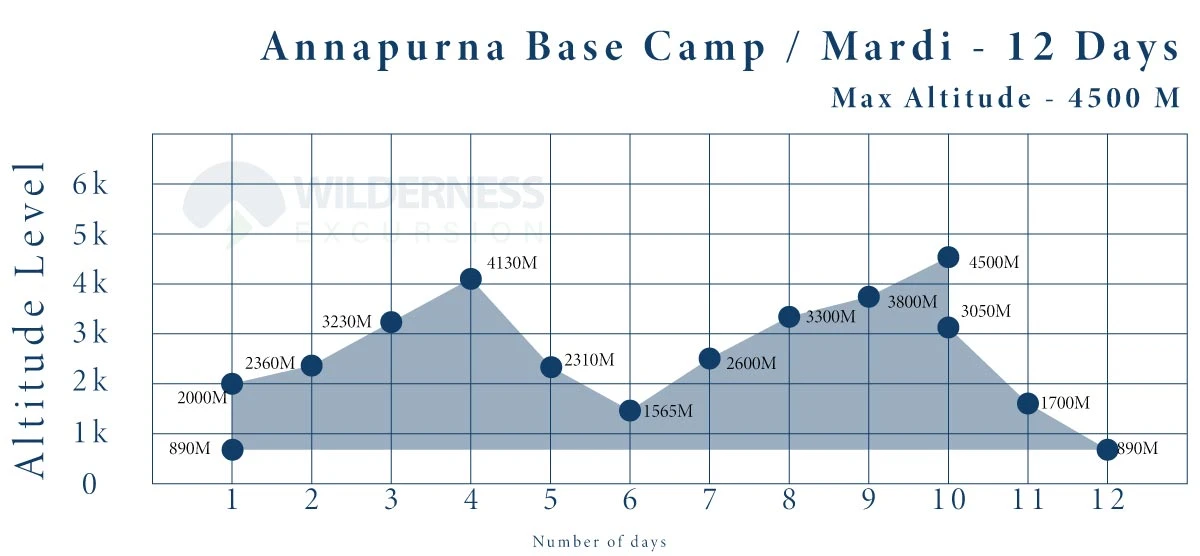
Day 01: Drive to Jhinu to Sinuwa (Altitude 2100 m): Approx. 6-hour walk
Day 02: Trek to Deurali (Altitude 3230 m): Approx. 7 hours walk.
Day 03: Trek to ABC (Annapurna Base Camp / 4130 m): Approx. 7 hours walk.
Day 04: Trek down to Bamboo (2310 m): Approx. 7 hours walk.
Day 05: Trek to Landruk Village (1,565 m). Approx. 8 hours walk.
Day 06: Trek to forest camp (2600 m): Approx. 6 hours walk.
Day 07: Trek to Badal Danda (3300 m): Approx 6 hours walk
Day 08: Trek to Mardi High Camp (3800 m): Approx 4 Hours walk.
Day 09: Excursion Mardi Base camp & trek to low camp: Approx
Day 10: Trek to Australian Camp (2100m) from Mardi Low Camp
Day 11: Trek to Phedi and back to Pokhara by Car.
Things to know about the cost for Annapurna Base Camp with Mardi Himal Trek and Booking options
Trek cost and variables
Every travel cost depends on the traveler's choices, and among these choices are the fixed and variable factors that contribute to the total cost. What are these factors affecting a package cost?
Fixed cost factors include government subsidies or any expenses required to be paid to government bodies on both the local and national level, such as conservation fees, municipal fees, national park entry fees, and other fees for special permits. These costs are applicable to any form of trekker, be it an independent trekker or someone booked through an agency. In trekking, fixed costs are not those costs that need to be paid, but such factors that don’t have alternate.
Now, variable costs are the remaining expenses that need to be covered when travelling anywhere. Transportation, lodging, and food are some of the basic needs for trekkers, along with proper gear. These expense heads has alternates, for example: transportation has multiple options for both ground and airways with different levels of pricing and services. Taking the variable costs into account, budget trips or luxury trips can be planned. How will this affect the pricing and cost for the trek?
Expenses like transportation and lodging have different levels of services; a private jeep costs more than a shared jeep or local ground transportation, and flight ticket fees cost more. For the lodgings, teahouses in the trekking route are normally rated around the same, but hotel stays near Pokhara lakeside, and Kathmandu have thousands of options to choose from with equal service level. The trips are planned according to service level and overall cost, hence the different pricing for similar trips.
Notes: Trip pricing is mainly backed by different kinds of services provided. So, an intimidating price may not be overpriced, nor can a cheap package provide quality services.
Booking options for Annapurna Base Camp with Mardi and the following costs
Trekking in Nepal has always been a free adventure, not free of financial expenses but of self-will. Following legal proceedings, any citizens of a free country can travel in Nepal with proper documents. The main question is, how can a person trek in Nepal from legal procedures to hiring a guide and booking options? Now, there are four ways of trekking in Nepal and all these options has its own perks and downsides. Let’s break down the ways of trekking in Nepal.
Private Bookings: With a limited number of trekkers from 1-3, you book your trek from a reputed trekking agency in Nepal. The agency acts as a legal advisor and guardian of your safe travel. The cost for private booking is USD 725 for a single booking and USD 670 per person for 2-3 bookings.
Pros:
- Timely departure and secured trip.
- Time saving, no hassle in the legal procedure for permits.
- Different service perks and a guided trek.
- Flexible planning.
Cons:
- More costly than group bookings.
- Plans can’t be changed or withdrawn easily during the trek.
Group Booking: The group booking process is similar to private booking, with an agency handling the paperwork and managing the trip. The difference is the number of Trekkers, which ranges from 4 and above. The cost for 4-6 trekkers is USD 640, and for 7-12 is USD 610. The group booking may have limited decision-making but also unlocks different perks, such as a huge margin in discount and free cost for a trekker for a group of 10.
Pros:
- Affordable cost and a secure, guided trek.
- Noticeable discount and Wilderness Excursions' exclusive FOC Policy.
Cons:
- Long planning and decision-making.
- Lack of possibility for sudden changes in Planning.
- Less flexible when compared to private bookings.
Service Trekking: Service trekking is different from regular bookings. In private and group bookings, you are provided a set of services, an inclusive package trip. Service trekking is choosing only the services needed to regulate a trek legally. How? To trek in Nepal, every trekkers are legally required to get a TIMs, conservation permits, and a guide. You can actually select these few services, pay the agency fee for arranging the service, and handle the rest of the trip budget yourselves, which includes transportation, lodgings, and food.
Pros:
- Affordable cost with a guided trip.
- Flexible and quick departures.
Cons:
- Self-management for running costs.
- Less secure and hidden costs.
- Lodging difficulties.
Independent Trekking: Basically, you are the whole responsible body of the trek who manages and plans the trip. Without relying on any local trekking agency, you map out the route and apply for necessary permits, while taking your time in Kathmandu.
Pros:
- Flexible route, can be changed in any way possible. Extend or end the trek early.
- Cost saving, no need to pay agencies for managing the trip.
- Flexible budget plan.
Cons:
- Route misdirection and possible threats in high passes.
- Hassle and time-consuming when applying for permits and managing transportation.
- Possible rescue delays in high altitudes, in the absence of any collateral.
Note: Hiring a guide and porter costs USD 25 and 15, respectively, per day. When hired through an agency, the cost covers their daily wage, insurance, and daily expenses during the whole trek as per the registered itinerary. For more detailed information, follow the given link.
Why book your next trip with Wilderness Excursion?
We are a registered trekking agency based in Nepal with decades of experience in organizing both group and private trekking and peak climbing. With 99% successful departure and completion rate, booking with us has its own different perks, such as our FOC Policy.
- We arrange TIMS cards and trekking permits, saving time and confusion.
- Local guides know routes, weather, and culture—reduces risk of getting lost.
- In case of altitude sickness or injury, we handle rescue and evacuation.
- Accommodation, food stops, and transport are pre-arranged.
- No need to research every detail—you can focus on the experience.
- Agencies plan proper acclimatization days and safe itineraries.
- Our guides help interact with locals, especially in remote areas.
- Trek guides and porters are properly insured with the required gear.
- Some treks require a registered agency to obtain special permits, which we are responsible for obtaining.
- You can trek comfortably without carrying heavy loads with the help of porters.
- Our guides explain traditions, monasteries, and local lifestyle, making the trek richer.
Booking procedure and required documents
Booking with Wilderness Excursion is simple and easy. In a few steps, your next trip will be arranged and depart on your preferred date and time. Follow the guided steps to book the 10-day Annapurna Base Camp with Mardi Himal trek.
- Click on the ‘Book This Trip”.
- Fill up the required fields in the form and preferred addons.
- Make a 15% advance payment to confirm the booking.
- Enjoy your holiday and stay in Nepal.
Documents required for booking
- Clear passport photocopy of all participants.
- Clear passport-size photo.
- Updated insurance copy.
Note: Once you book, our team will contact you regarding the documents required for processing the trek.
Instant trek departures available on fixed dates
Wilderness Excursion Pvt. Ltd provides fixed departures on fixed dates given on our websites. Along with customized trips, you can also choose to book the trip instantly if the given package and itinerary suit you. Our team will arrange your trip in accordance with the fixed package service.
Pros and cons of booking instant departures
Pros
- Fixed departure for any number of participants ranging from 1 to 7.
- Upgradeable services and affordable pricing.
- FOC policy is applicable if requirements are met.
- Light itinerary customization is possible.
Cons
- Heavy customization to the trek itinerary is not advised.
- Less time to prepare and discuss the contents.
- A day is still required for legal proceedings (Trek permits).
Itinerary
Expand allYou will be picked up by your assigned Annapurna Base Camp Trek and Mardi Himal Trek guide at around 7:30 AM from the hotel. You will take a scenic drive to the Jhinu Danda route through the Kande-Nayapul and leave the highway at Nayapul, then take a 4WD off-road to Jhinu Danda, where we begin our Annapurna Base Camp hike combined with Mardi Himal. It will take some 3 to 4 hours by public jeep from Pokhara, and the trek to Sinuwa (2300m) will be some 10 km and takes around 4 hours walking. Overnight in the teahouse.
Trek from Sinuwa to Himalaya at an altitude of 2900 masl. The Annapurna Base Camp Route trail goes up to Upper Sinuwa offers a good view of Mount Machhapuchhre (6993m). Then the trail enters the lush green forest of rhododendron, bamboo, and oak trees. Soon we reach the place called "Bamboo" for a tea break. We follow the valley of Modi Khola trekking to the Himalayas today via Dovan for lunch. And after a nice lunch break, we resume the hike to Annapurna Base Camp. Overnight at Himalaya
From the Himalayas; we head upward to Deurali via Hinco Cave. The view becomes brilliant just after passing Deurali. The alpine flowers are so amazing if you are trekking in August and early September. After walking for some 6 hours at the beautiful place of Machhapuchhre Base Camp. Overnight in teahouse.
Early in the morning; we make an excursion in lifetime experience to Annapurna Base camp at the altitude of 4130 meters above sea level. Enjoy the majestic view of giant peaks and feel yourself at the "Heart of Himalaya". We enjoy the hot tea/coffee break here with viewing the sun touching the mighty Annapurna Himalaya and then retrace back to the hotel at Machhapuchhre Base camp and trek back to Bamboo for an overnight stay.
Today; it is also a long day. We trek the same way back to Chhomrung and then descend down to Jhinu Danda where we cross a long hanging bridge, and the trek continues to Landruk Village via New Bridge. Overnight in teahouse.
We begin our trek early after a hearty breakfast. Your trail rises again along stone staircases overviewing Landdruk and Ghandruk village showcasing the valley floor. Continue steep uphill through the beautiful birch and rhododendron forest. The Annapurna range in the backdrop is absolutely enchanting, you might also get a glimpse of rare birds before arriving at Forest Camp. Overnight in teahouse.
We will take a steep ascent through the juniper and Rhododendron forest from the Forest Camp. The view becomes more attractive and blissful as you get to Badal Danda. You will be witnessing spectacular views of the Machapuchare, Mardi Himal, and the Annapurna ranges. We will spend the night at the teahouse.
After breakfast. trail ascends above tree line, though rhododendron bushes still can be seen. There are also chances to see colorful Pheasant (Nepalese National Bird; Danphe) Today will be a short hike and Mount Fishtail, Annapurna South, and Hiuchuli become much bigger as you approach High Camp. Overnight in a teahouse at Mardi High Camp.
You will leave your main baggage at the teahouse and set off with a day bag winding the narrow tail of Yak and sheep grazing Land. Your walk to View Point feels heavy as there is limited oxygen, though mesmerizing landscape and stunning view of Mardi Himal, Mt. Machhapuchhre (fishtail), Hiuchuli, Annapurna South, Annapurna I, Tent Peak, Annapurna II, and many more Himalayan range makes an unforgettable day of the trek. We can even further hike to Mardi Himal Base Camp at 4500 meters from sea level. Return to High Camp for Lunch and descend to Low Camp for a comfortable night's sleep.
You would retrace to Forest Camp and the trail continues through the dense forest to Pitam Deurali (2,142m/7,030ft) at the perfect Lunch Time. The Annapurna Panorama Trekking trail joins after Lunch to Pothana surrounded by forest. Final 30 minutes gentle climb to wide open lawn Australian Camp with comfortable Lodge. Enjoy the Sunset if the weather favors you.
The morning begins with Annapurna Sunrise and the glorious Annapurna Himalayan Range before breakfast. Proceed through the Rhododendron forest and drop down to the village of Dhampus; a peaceful village with magical Himalayan on the backdrop. Get rewarded with outstanding mountain views. You pass some scattered villages and fields while descending Phedi and a short drive to Pokhara. Transfer to your hotel and free afternoon.
10-day fast-paced Annapurna Base Camp Trek with Mardi Himal itinerary for young and fit experienced trekkers those willing to test their limit for adventure trekking.
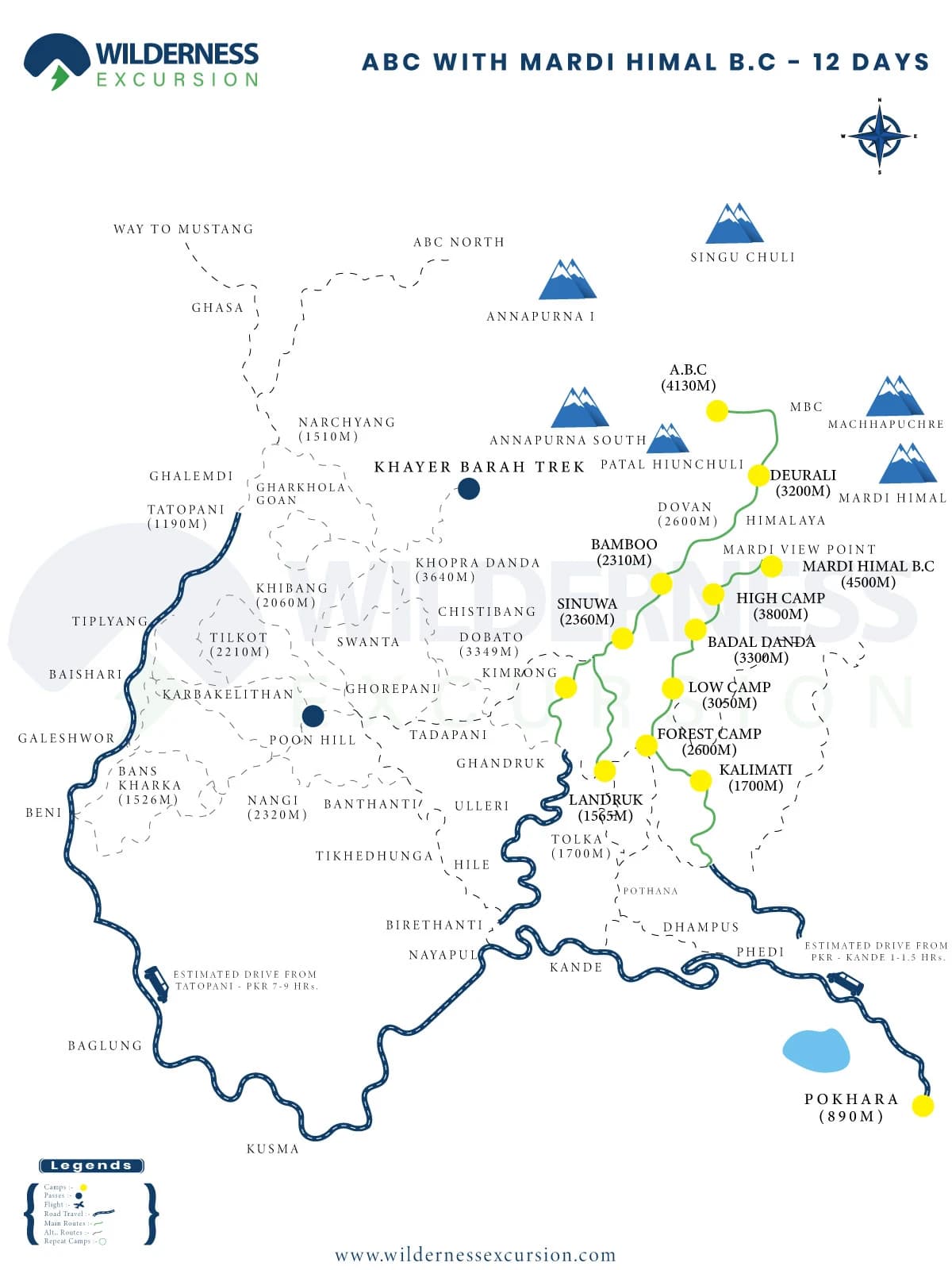
Route Map
Altitude Chart
Still Confuse?
Download brochure or customize your trip.
Cost Details
Includes
- Transfer to and from trekking in Pokhara.
- A documented Mardi Himal and ABC trek local guide.
- Necessary Mardi Himal and Annapurna BC Trekking Permission.
- Accommodation on a twin/triple shared basis in a teahouse lodge for 3 nights.
- Meals: 10 breakfasts, 11 lunches, 10 dinners.
- Guide fee with all his / her expenses during the trek.
- Transfer to Pokhara by public bus and taxi from the trek ending point.
- Government taxes and company service charge
Excludes
- Transportation, accommodation, and meals in Pokhara before and after the trek.
- Bills of bar and beverage drinks during the trek to Mardi Himal and ABC Trek.
- Personal trekking gear and travel insurance
- Personal nature expenses such as toiletries, laundry, and phone calls.
- Medication and rescue evacuation in case of emergency.
- Porter to carry your main pack ( it will cost US$ 20 per day/ porter)
- Tips for guide and porter
Add-ons & Options
At Wilderness Excursions, we have 13 years of excellent operation and decades of expertise in leading treks in Nepal. To further enhance your Annapurna Base Camp Trek, we’re pleased to introduce exclusive add-ons for an even more exceptional adventure.
- Kathmandu to Pokhara Flight Ticket at USD 99: Enjoy a hassle-free flight from Kathmandu to Pokhara, including dedicated airport transportation.
-
Private Jeep Service, USD 60: Upgrade your land transportation to a private Jeep for comfortable travel. Cost can be shared by two trekkers or as per the number of participants
-
Tourist bus between Kathmandu and Pokhara US$ 25: Allow us to manage your tourist bus seat bookings for seamless land travel between Kathmandu and Pokhara, saving you valuable time. Please inform us if you prefer air travel (25 Mintutes flight which costs US$ 98 per adult / per flight)
-
Accommodation Booking in Pokhara USD 35 to 45: Additional Night Accommodation in Pokhara – USD 45 (Double Room) and USD 35 Single Room
Dates & Availability
Check our published date! If it doesn’t match, we are happy to customize your tour perfectly to suit your interests and needs. Contact us to create a unique travel experience for you
Essential Information
Trek difficulty for different age groups
The Annapurna Base Camp and Mardi Himal trek is beginner-friendly when trekkers complete it individually, despite being at altitudes of 4130 to 4500 meters above sea level. The combined route is strenuous even for seasoned trekkers. How?
Trek difficulty is measured based on multiple factors. Details such as trek duration, average walking hours, altitude, trail, facility, and time affect trek difficulty. The Annapurna Base Camp and Mardi Himal trek is difficult for an average trekker due to its circling trails, especially for those taking the 11-day trek that combines two different trekking trails with contrasting altitudes. Our standard itinerary begins with a drive to Jhinu Danda and a trek to Annapurna Base Camp and retraces the same path to Jhinu Danda, takes a detour to Landruk Village, and follows the Mardi Himal trail from Forest Camp. Now the details are in the route and differentiating trails to Annapurna Base Camp are The Southern Annapurna Base Camp trail goes along the hills from Jhinu and follows the Modi River to Machhapuchre Base Camp. The trail is mostly in river valleys with short uphills in Chhommrong and Sinuwa. The Mardi Himal trail features a mixed route, primarily uphill, leading to the viewpoint and base camp. From Landruk, the trail officially enters the Mardi trekking trail, which features dense forest until Low Camp and the alpine ridge trail from Badal Danda to Base Camp. The main reason for trek difficulty is due to its variation in trails from river valleys to alpine ridges and the constant change in altitude.
Trek difficulty for different age groups
- Beginners of all ages: Strenuous
- Experienced Trekkers (16-50): Medium Hard
- Experienced Trekkers from 51 to 69: Medium Hard
- Trekkers above 70: Strenuous
Note: Trekking Annapurna with Mardi for the age group below 16 is also possible, but pre-discussion is required. Although Wilderness Excursion has successfully arranged trips for children under 16, it is customary to take precautions.
Weather and climate in Annapurna Base Camp and Mardi Himal
Weather in high-altitude regions is unpredictable. Although climate patterns can be determined from year to year, weather can be tricky. Due to such uncertainty, trekking is done for a specific time period. Generally, in the Himalayas, clouds open for a brief time period in the early morning, so never be disappointed if views are obstructed by drifting clouds.
Climate is a global change, and unlike weather, it isn’t temporary. The changes are slow but constant, and recently, they have been noticeable. Half a decade back, Nepal’s renowned months for trekking were from March to May and September to November, but in the present day, these specific months are also being affected by the climate with unpredictable weather conditions. The usual patterns of rain, drifting clouds, and a hazy morning now affect trekking season.
Road structure and trekking trail conditions of Annapurna and Mardi
Road infrastructure is a necessary development for the country, and it has been affecting the traditional trekking trail, but the local trekking committee has always been determined to preserve and find the best adventure route for trekkers. Our standard itinerary avoids roadways up to 96% of the total trek. How?
At the beginning of the trek, you drive to Jhinu Danda, covering half of the long-standing route to Annapurna Base Camp. From Jhinu Danda, it’s a completely untouched trail to Annapurna Base Camp, and you retrace the same trail to Jhinu Danda. Afterwards, you trek down to Landruk and start the Mardi Himal trail, passing through the dense forest of Forest Camp and the colorful lodges in Low Camp, and continuing to the alpine ridges from High Camp to Mardi Base Camp. The trek retraces its path to Forest Camp, then heads toward Australian Camp and Dhampus village, using both on-road and off-road routes to Phedi before driving to Pokhara.
Flight and ground transportation for the trek with cost
During the trek, transportation is mostly local buses and jeeps, with flights operating only from Kathmandu to Pokhara, costing USD 100 one way per person. If you are traveling from Kathmandu on a tourist bus, it will cost you around USD 25. Transportation during the trek from Pokhara, in accordance with the itinerary, a shared jeep or car is provided based on the number of trekkers. But you can always upgrade your travel to a private jeep from Pokhara at the lowest price of USD 60.
Porter and guide information for the trek
Our package cost of USD 670 includes a licensed trek guide for the whole trip. He/She will be responsible for your successful journey, as much as you are responsible for yourself. Although the package cost doesn’t include a porter to carry your main pack. Hiring a porter service is also possible for USD 20 per day. The cost will cover wages, travel expenses, and insurance; the same goes for guide service.
Note: Porters are only required to carry 20 kg, and for any weight exceeding 20 kg, we recommend hiring extra porters if necessary.
Permits and required entry fees for Annapurna Trekking
Both Annapurna and Mardi Base Camp are protected under the Annapurna Conservation Area Project; trekkers are legally required to obtain ACAP permits from the Nepal Tourism Board, Bhrikutimandap. The conservation fee is 3000Nrs per person for all nationals except SAARC and 1000Nrs per person for SAARC nationals. Children below 10 years are free of cost for the conservation fees.
Accommodation and food in the Annapurna and Mardi Base Camp
The Annapurna region facilitates satisfying lodges and food items that are neither too luxurious nor too basic. A typical lodge in Annapurna and Mardi accommodates a shared room for two people. The rooms are basic with two beds, a table, quilts, and a stunning view of the Himalayas. In the lower region, lodges provide attached bathrooms, which can be hard to find in high camps and base camp areas.
In the context of food and beverages, the lodges and teahouses on the trail facilitate a basic restaurant menu. Although the menu may seem basic, they provide various items for lunch, dinner, breakfast, and snacks, including teas and different hot drinks.
Packing and preparation for the Annapurna Base Camp and Mardi Himal
Packing Tips
- Layered clothing system (base, mid, and outer layers).
- Insulated down jacket for cold mornings and nights.
- Waterproof and windproof jacket and pants.
- Comfortable, high-ankle trekking boots.
- Thermal gloves, woolen hat, and neck buff.
- Sleeping bag (–10°C to –15°C recommended).
- UV sunglasses, sunscreen, and lip balm.
- Reusable water bottles with purification tablets.
- Headlamp with spare batteries.
- Power bank or portable charging backup.
Preparation Tips
- Build cardio stamina through hiking, running, or stair climbing.
- Strengthen legs for steep ascents and descents.
- Plan proper acclimatization during higher elevation days.
- Maintain hydration habits before and during the trek.
- Learn basic symptoms and prevention of altitude sickness.
- Test and adjust the gear before starting the trek.
- Follow a balanced diet for sustained energy.
- Set aside daily personal expenses (USD 10–15).
- Prepare mentally for basic teahouse facilities.
- Check weather conditions and plan accordingly.
If you want to have more tips for a successful trek in Nepal, follow the given link.
Altitude sickness and safety tips
The Annapurna Base Camp and Mardi Himal Trek reach elevations above 4,000 meters, where oxygen levels decrease, and altitude sickness can occur if proper care is not taken. Despite stable weather during peak seasons, rapid elevation gain and physical exertion can affect trekkers. Recognizing early symptoms and following essential safety practices helps prevent serious health risks. A gradual ascent, proper hydration, and responsible trekking habits ensure a safe and enjoyable journey across both the Annapurna Base Camp and Mardi Himal trails.
Signs of Altitude Sickness
- Persistent headache and dizziness at higher elevations.
- Nausea, loss of appetite, or vomiting.
- Shortness of breath, even at rest.
- Fatigue, weakness, and disturbed sleep.
- Loss of balance or swelling of the face and hands.
Safety Tips for the Trek
- Follow a gradual ascent with proper acclimatization.
- Stay hydrated and avoid alcohol or smoking.
- Walk at a steady pace and avoid overexertion.
- Inform your guide immediately if symptoms appear.
- Carry basic medication and travel insurance.
Annapurna Base Camp and Mardi Himal Trek - 11 Days FAQs
The trails to both Annapurna and Mardi base camps are well-preserved by the conservation team and local committees. On the Annapurna trekking route, after crossing Chhomrong village, the trail to Sinuwa is a direct uphill, crossing a suspension bridge. After Deurali, the uphill to EBC is only a few uphills. As for the Mardi Himal trek, once you officially enter the Mardi trekking trails, from Landruk, the trail is mostly uphill through dense forest and alpine grasslands with a short distance of plain.
Local ISPs now support most places in the well-developed Annapurna trekking region, providing internet access and online banking services. But personally, we do not recommend relying heavily on such services. Due to unstable and congested networks, the internet can be slow and unreliable. ATMs are not available, nor are any local banks, so we suggest carrying cash, which can be withdrawn from nearby banks in Pokhara or exchanged at a money exchange for more reliable methods.
Mobile networks like NTC and Ncell work in lower regions, but coverage becomes weak or unavailable near Annapurna Base Camp and along the Mardi Himal ridge sections
The trek is considered moderate, involving several uphill and downhill sections, stone staircases, and long walking days. Basic fitness and preparation are recommended.
Hot showers and charging are available in most lodges, with extra charges per shower and device to be charged. The agency doesn’t cover these costs.
Both local agencies and the Nepalese government recommend trek guides. They are not only there to guide the trail but are also in charge of your secure succession and rescue coordination during emergencies and are your legal trek guardian.
No, both Annapurna and Mardi Base Camp fall under a conservation area and are not close to the border. Special permits are only required when trekking to highly protected and sensitive areas like Throng La in the Annapurna Circuit and other upper regions of the Himalayas.
There are no designated grocery shops. Places like Chhommrong, Sinuwa, and Australian Camps do have small roadside shops, but you can always buy things like filtered water bottles, toilet paper, and packaged snacks from the lodge you were staying at or in the teahouses.
There are actually multiple water taps near the camps and the village used by locals. Foreigners who are not familiar with the environment are not recommended to use those waters directly since unfiltered water might not be habituated to one's body. In such cases, you can always buy a bottle of water from hotels or shops, though prices may rise as you trek. Another option is to carry a filter tablet or a portable water filter and use tap water.
Yes, as the trek reaches above 4,000 meters, there is a risk of altitude sickness. Proper acclimatization and awareness of symptoms are important.
What Our Clients are Saying?
based on 4 reviews
5 Days Ghorepani Poon Hill Trek with Best Guide Yuhan
An Unforgettable Ghorepani Poon Hill Trek with Yuhan – Highly Recommended!
My Ghorepani Poon Hill Trek with Yuhan as my guide was an incredible experience. From start to finish, he was professional, attentive, and genuinely caring, ensuring every moment was enjoyable....

Enrique Mantas- Spain
April 27, 20255 Days ABC Trek; Excellent service
We received first-rate assistance for our ABC trek—five days and four nights of an unforgettable adventure! Our guide Rahul was incredibly well-versed in trekking, ensuring both safety and enjoyment. The journey was full of fun, with breathtaking views and great...

Carmen C- Malaysia
March 25, 2025Annapurna Base Camp Trek – A Journey to Remember!
The trek to Annapurna Base Camp was an incredible experience! Our guide was highly experienced and took excellent care of us throughout the journey. The guesthouses provided hearty, delicious meals that kept us energized every day. Thanks to the company’s...

Py C- Malaysia
March 23, 2025Adventures Tailored for You


Need Help? Call Us+977 9851042153