Things to know when trekking to Annapurna North Base Camp
Important notes
Trekking difficulty: The northern base camp of Annapurna is medium-hard for professional trekkers but may pose significant difficulties to beginners due to the unavailability of timely accommodation and suitable foods.
Trek duration: The itinerary to the northern base camp is 7 days, which can be customized to the trekker’s personal preferences.
Accommodation: Most of the places now accommodate teahouses and lodges, but some parts may require camping depending on the location and time.
Best time to trek: Trekking the north base camp is best done during trekking seasons from late March to early June and from September to November.
Avg trekking hours: On average, we trek 6-7 hrs a day for good rest and gradual acclimatization.
Total trekking days and drive day: The itinerary is for 7 days, but the total trekking will be for 6 days since we will be driving back to Pokhara on our last day.
Arrival and Visa in Nepal
Nepal provides an “on-arrival” visa with a quick and simple procedure. You can get your visas at Tribhuvan International Airport after applying at the Department of Immigration.
Once you arrive at the airport, follow these simple procedures for a tourist visa.
- Fill in the 'Arrival Card.'
- Fill in the online ‘Tourist Visa' form. You can fill it out online before you arrive at the Department of Immigration or use the kiosk machines upon arrival at the airport.
- Make payment at the bank according to your visa requirement (15/30/90 days).
- Get the receipt.
- Proceed to the immigration desk with your online form, payment receipts, and your passport.
- Hand in your documents to the immigration officer for visa processing.
On Arrival Visa Fee
- 15 Days – 30 USD
- 30 Days – 50 USD
- 90 Days – 125 USD
Trekking difficulty – Who is it for?
The northern base camp lies beside Annapurna I and was rarely known to trekkers, so the number of teahouses and trekking lodges was limited. Trekkers had to spend a few days in a tent, which was difficult for beginners and professionals who didn’t have any prior camping experience. But due to the recent development of teahouses near the northern base camp, Annapurna North Base Camp now accommodates more comfortable stays and resting points. So, the northern base camp is a beginner-friendly wilderness trek in the Annapurna region.
Altitude and acclimatization
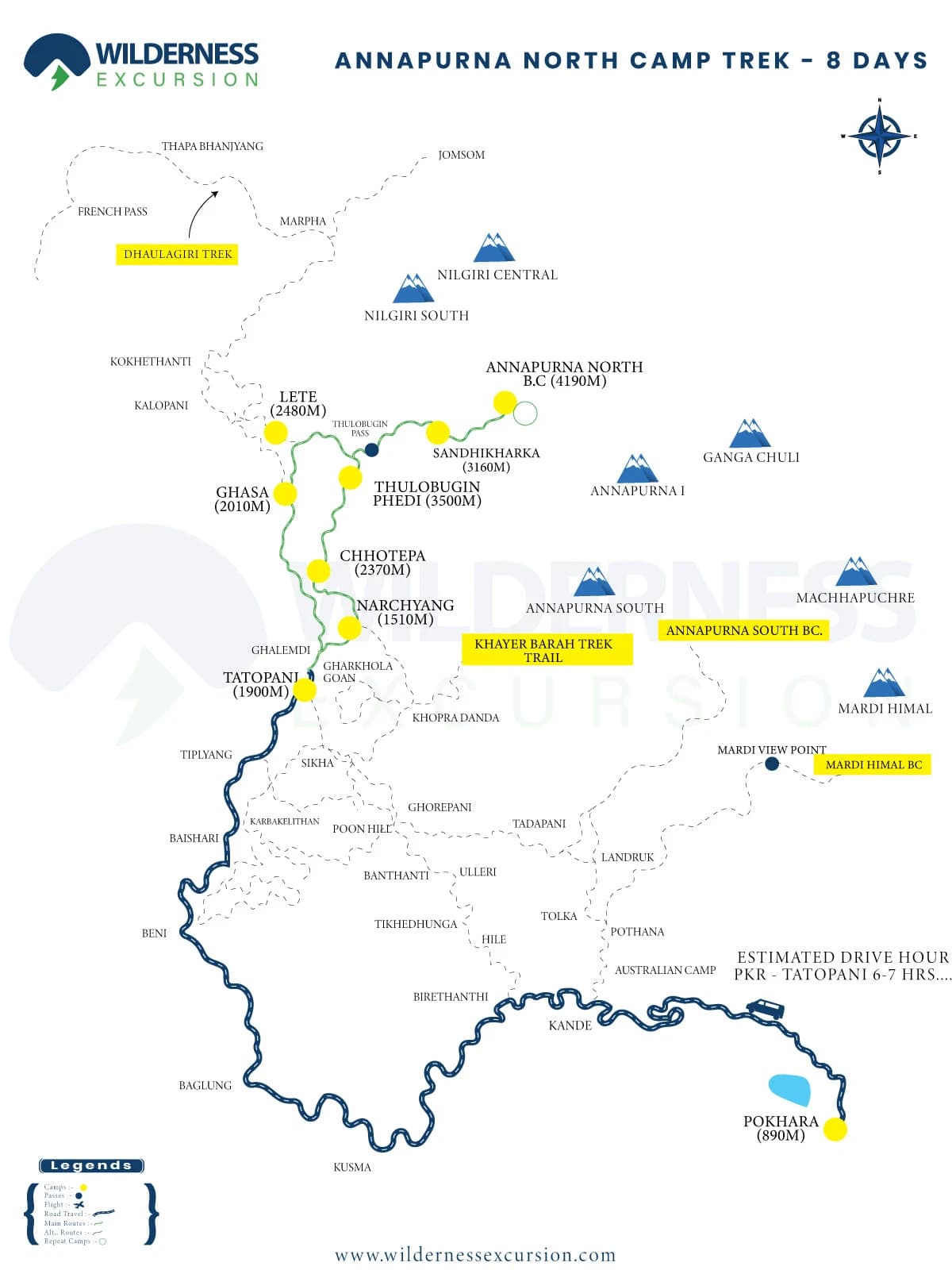
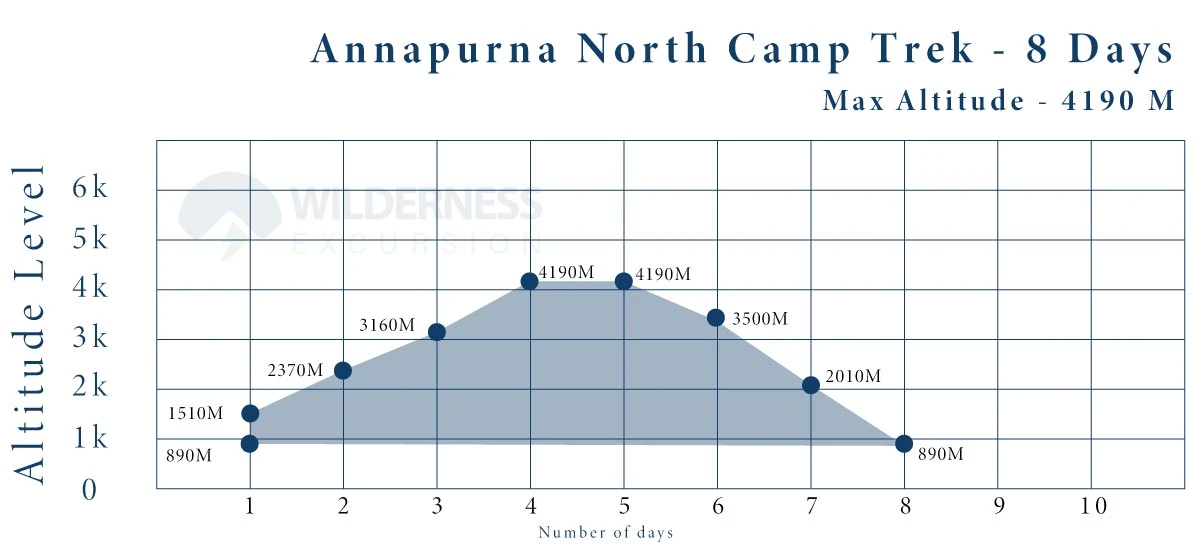
The highest altitude during the whole trek is 4190m, which is 60 meters higher than the popular Annapurna Southern Base Camp. The trek officially starts from Narchyang at an altitude of 1510m for better and gradual altitude gain and ends around the same altitude of 1900m at Tatopani.
Table: - Altitude gained per day
| Trekking day |
Altitude gained |
Altitude difference |
| Day 01 |
1510 meters |
620 meters |
| Day 02 |
2370 meters |
860 meters |
| Day 03 |
3500 meters |
1130 meters |
| Day 04 |
4190 meters |
1410 meters |
| Day 05 |
2480 meters |
-1710 meters |
| Day 06 |
2010 meters |
-470 meters |
| Day 07 |
890 meters |
-1120 meters |
Weather and seasonal conditions
The weather during the trek heavily depends on the season you’re visiting. For instance, during the spring season, early March can be really stable with sudden clear and crisp skies and heavy-to-light rain in minutes. While the monsoon and winter seasons are no-go zones for the Annapurna North Base Camp. The autumn season is considered the all-rounder trekking time for its stable and clear weather. So, depending on the season, month, and time, your weather experience may vary slightly.
The best option is to contact us and query in real time to know the weather in Kathmandu and generally in Nepal. Right before the departure or booking, you may contact us to know the weather in specific locations.
Accommodation Standards
Unlike the southern base camp, this trek leans more towards wilderness and remote trekking. So, in general, you may not find any luxurious hotels, and the only accommodation is in local teahouses or trekking lodges specifically made for a night's stay. While near the base camp, you may possibly require camping in tents, depending on the situation and whether lodges are available or not during the visit. So, overall, the only accommodation is teahouses and lodges, which have a two-in-one shared room and a small dining room with fitted heaters and a great view of nature. It may not be a luxurious night, but it will be the most comfortable night of your life.
Food and Drinking Water
Now it is quite tricky when it comes to food and drinking water. Although every camp in the Annapurna region follows a similar pattern of old diners with fixed menus and varieties, it may slightly differentiate when you trek higher towards the base camp. The food options are mostly fried or steamed, and the ingredients used are something that can be stored for a long time, unlike fresh vegetables. So, the more you gain altitude, the fewer your food options will be. But drinks are different: every lodge has access to a remote water supply from the mountains that is clean and drinkable, so hot drinks such as tea, coffee, hot lemons, and similar beverages are possible.
For drinking water, if you’re uncomfortable with tap water in lodges or trails, you can use purification tablets or portable gadgets to filter water and reuse the tap water.
Permits and entry requirements
The Northern Annapurna Base Camp is protected under the laws of the Annapurna Conservation Area project, which is similar to the Southern Base Camp. To enter the ACAP premises, trekkers must have conservation permits issued by the Nepal Tourism Board. Trekkers booked through the agency won’t have to hassle for permits since the agency takes care of basic requirements, but for those who are trekking independently, you can visit our website for more information regarding permits and fees.
Transportation and route access
After arriving at Tribhuvan International Airport, you can choose to fly directly to Pokhara International Airport. Or if you’re staying in Kathmandu for a night and have a brief meeting with the agency before departure, you will have two options: either take a flight to Pokhara, which takes about 20 minutes after take off, or take a tourist bus that departs at 7:00 AM, which takes around 8-9 hours. The rates are 99-100 USD per flight and 25 USD for a bus seat, respectively.
Annapurna Base Camp and Annapurna North Base Camp comparison
If you're having a dilemma on which trek to choose between Annapurna Base Camp and the Annapurna North Base Camp, read our article on a comparison guide between the Annapurna Base Camp and the North Base Camp.