From the gateway to the Annapurna Range and the valley of the lake, Pokhara. Annapurna Base Camp is a week-long trip through the dense hills of Nepal, featuring a gradual ascent towards the alpine ridges that trail the Modi River. With a package cost of USD 465 per person, the Annapurna Base Camp is a perfect week's escape.


Annapurna Base Camp Trek - 7 Days
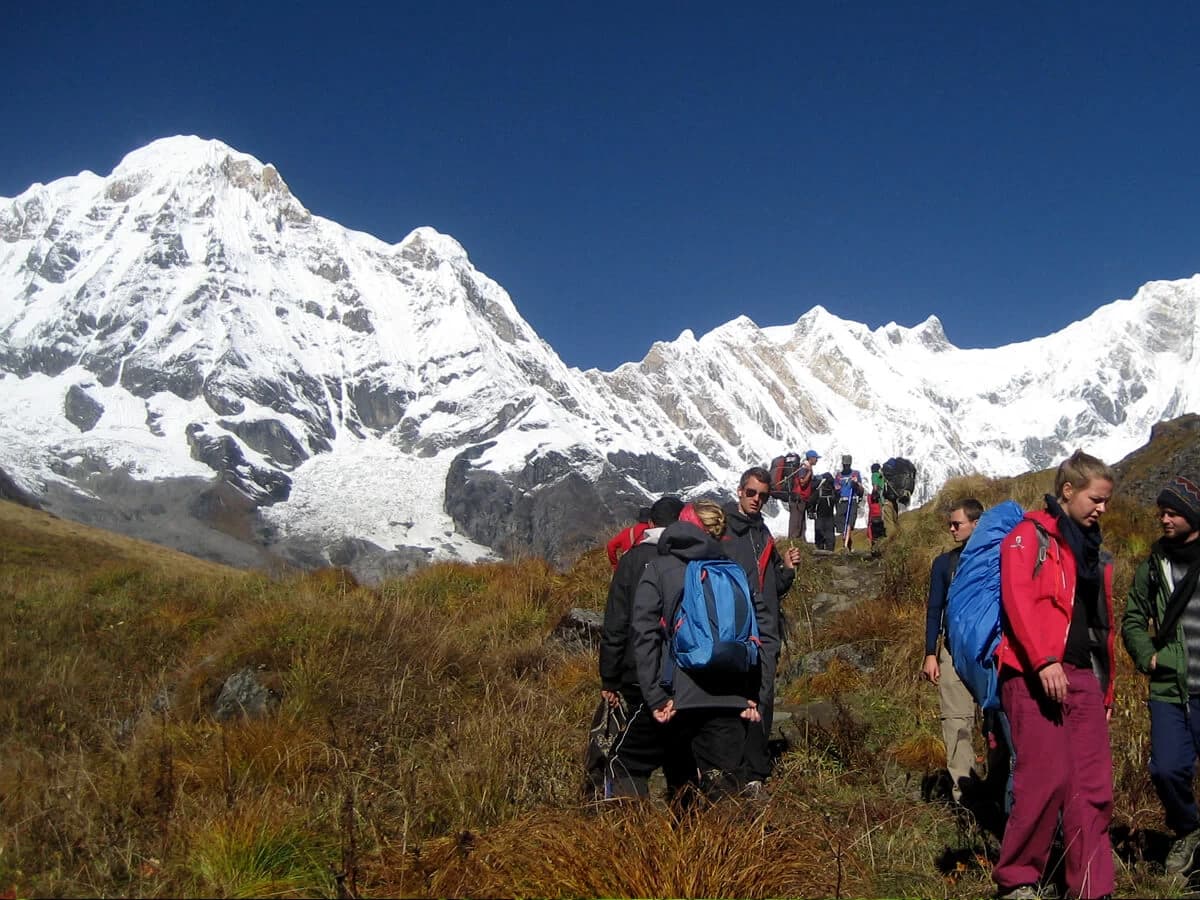
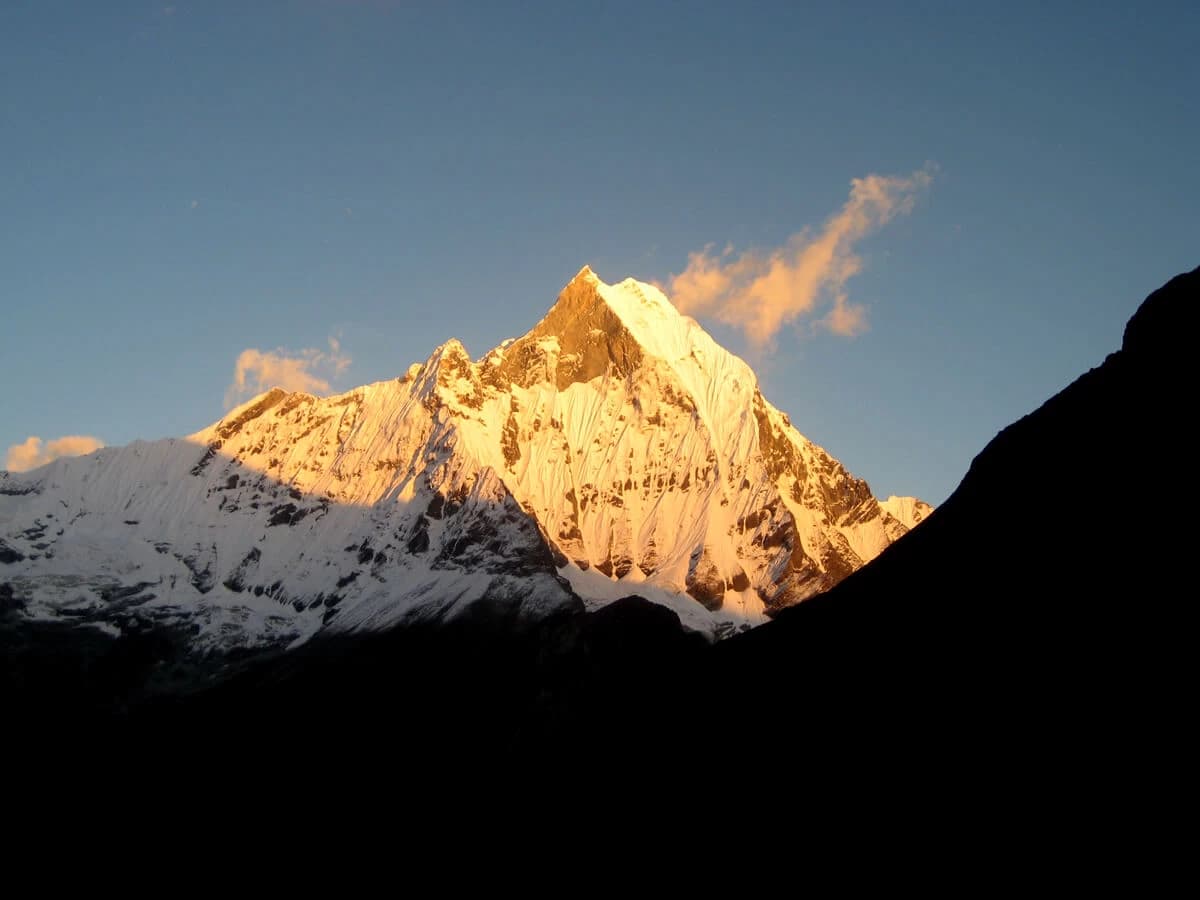
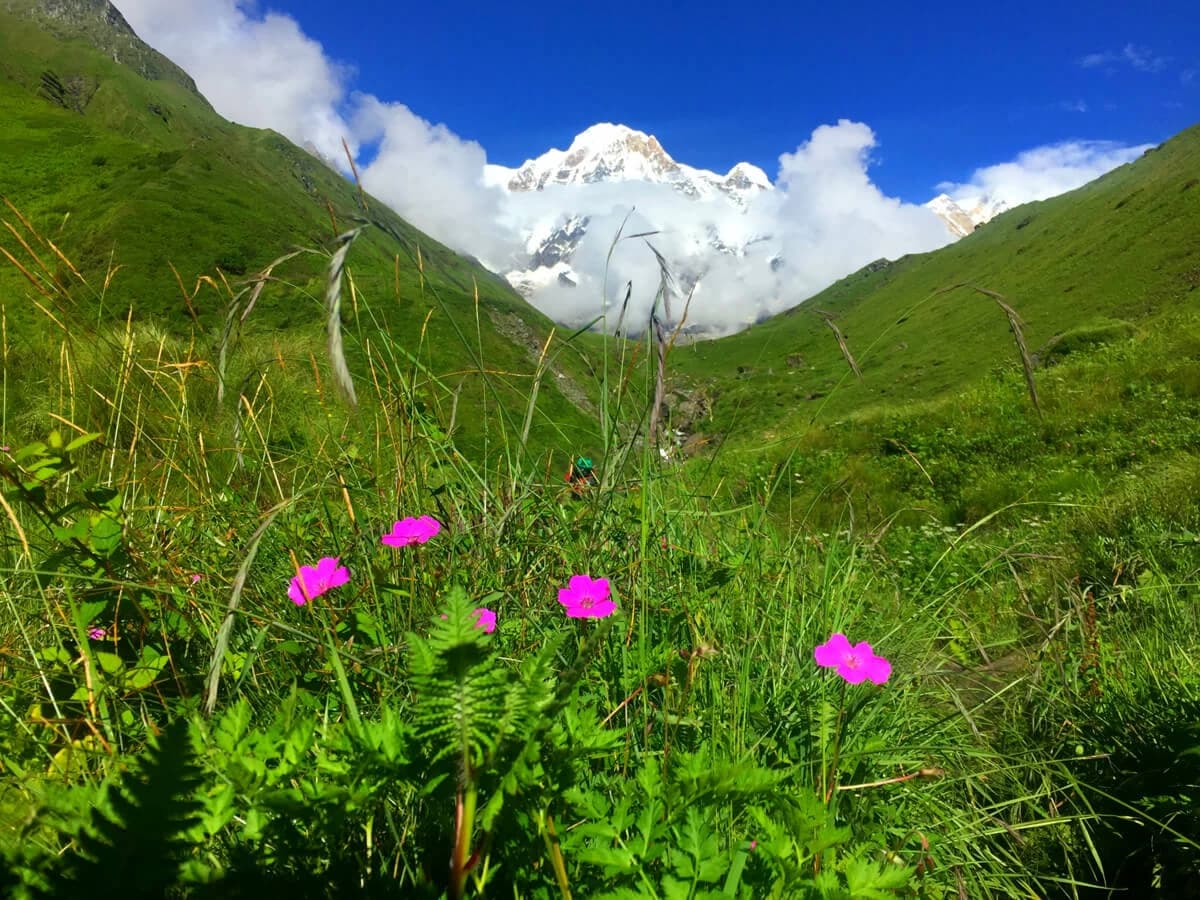
Duration
7 Days
Trip Grade
Medium Hard
Maximum Altitude
4130 Meters
Group Size
Max 15 Person
Activities
Trekking
Starts
Pokhara
Ends
Pokhara
Best Time
Sept, Oct, Nov, Dec, Mar, Apr & May
The Annapurna Base Camp
Located in the Northwest of Kathmandu and the northern part of Pokhara, the Southern Base Camp of Annapurna is one of the most popular and well-known trekking routes among both foreign travelers and locals. At an elevation of 4190 m above sea level, the base camp is situated at the center of the Annapurna South and Mt. Fishtail. Home to notable animals and birds such as the snow leopard, Himalayan tahr, blue sheep, musk deer, and the Himalayan black bear, protected under the Annapurna Conservation Area Project. The southern Annapurna Base Camp is the destination of euphoria for every beginner and professional trekker.
The naturally ever-changing valley of the Annapurna Range captivates visitors with its immeasurable beauty, snow-capped mountains, and peaks. From the lush, dense forest of oak trees to alpine grasslands, the path leads through rock spires from both sides towards the lap of the Himalayas, closer than ever.
Highlights of the Annapurna Base Camp
- Witness breathtaking sunrise and sunset views over Mt. Annapurna I (8,091m), Mt. Annapurna South, Mt. Hiunchuli, and the iconic Mt. Machhapuchhre (Fishtail), surrounded by a natural Himalayan amphitheater.
- Trek through the heart of the Annapurna Sanctuary, a spectacular glacial basin enclosed by some of the world's highest and most beautiful snow-capped peaks.
- Experience the unforgettable trail between Machhapuchhre Base Camp and Annapurna Base Camp, where towering mountains rise dramatically on every side.
- Walk through lush rhododendron forests that burst into vibrant shades of red, pink, and white during the spring trekking season.
- Explore diverse landscapes ranging from subtropical forests and river valleys to alpine meadows, glaciers, and high Himalayan terrain.
- Spot unique Himalayan wildlife, including Himalayan thar, barking deer, Himalayan monal, langurs, and various mountain bird species.
- Pass through traditional Gurung and Magar villages, where ancient customs, warm hospitality, and mountain lifestyles remain deeply rooted.
- Stay in charming teahouses and experience authentic local culture, cuisine, and daily life in remote Himalayan settlements.
- Walk across terraced farmlands, bamboo forests, cascading waterfalls, and suspension bridges that showcase the natural beauty of the Annapurna region.
- Relax in the natural hot springs of Jhinu Danda, a perfect place to soothe tired muscles after days of trekking.
- Enjoy ever-changing mountain panoramas throughout the journey, with every day offering new perspectives of the Annapurna range.
- Follow one of Nepal's most popular and rewarding trekking routes, suitable for both first-time trekkers and experienced mountain enthusiasts.
- Capture countless photography opportunities, from dramatic mountain landscapes and star-filled skies to traditional villages and alpine scenery.
- Experience a perfect combination of Himalayan adventure, cultural immersion, wildlife encounters, and world-class mountain views in a relatively short trekking itinerary.
Why book Annapurna Base Camp with Wilderness Excursion?
- We arrange all necessary Annapurna Conservation Area permits and trekking documentation, allowing you to focus entirely on the adventure ahead.
- Our professional local guides possess extensive knowledge of the Annapurna region, mountain trails, weather patterns, and high-altitude trekking conditions.
- Every aspect of your journey, including accommodation, meals, and transportation, is carefully organized to ensure a seamless trekking experience.
- Skip the hassle of trip planning and logistics as our experienced team manages all arrangements from arrival to departure.
- Our well-designed 7-day itinerary is crafted to maximize comfort, safety, and enjoyment while reaching Annapurna Base Camp efficiently.
- Trek with knowledgeable guides who share fascinating insights into Gurung and Magar culture, local traditions, and life in the Himalayan villages.
- All guides and porters are properly trained, insured, and equipped to provide reliable support throughout the trek.
- Enjoy comfortable teahouse stays and carefully selected overnight stops that enhance your overall trekking experience.
- Porter assistance is available to help reduce the burden of carrying heavy loads, allowing you to enjoy the mountain scenery more comfortably.
- Experience the breathtaking Annapurna Sanctuary with the confidence of having a professional and safety-conscious trekking team by your side.
- Our team closely monitors your well-being throughout the trek and guides altitude awareness and safe mountain travel practices.
- Receive personalized service, flexible support, and prompt assistance before and during your trek to ensure a memorable Himalayan adventure.
- Travel with a trusted local operator committed to responsible tourism, environmental sustainability, and supporting mountain communities.
- Wilderness Excursion also offers special free-of-cost benefits under selected conditions, providing additional value and flexibility for your Annapurna Base Camp journey.
Booking options with Wilderness Excursion
With more than a decade of experience, Wilderness Excursion is versatile in booking treks with personalized itineraries and needs. From small private family trips to large groups, we book, arrange, and manage treks for any age group with possible requirements. Our standard trek packages are focused on delivering affordable costs, with discounts on each additional booking. Currently, we provide multiple booking options, and each booking has its own perks.
- Private booking for individuals: Although most agencies don’t provide services to individuals, we arrange bookings for solo trekkers and provide personal guides and porters upon inquiry. The booking cost for solo trekkers is USD 650, which includes basic and daily trekking needs. Note that any changes or additions to services are possible.
- Private booking for 2-3 pax: With a standard package cost of USD 465 per person, the package includes similar services but at a lower cost and complimentary benefits compared to a solo booking.
- Family bookings for 4-6 pax: The package for 4-6 people costs USD 445 per person, with similar cost details mentioned on our webpage, and additional complimentary benefits are also provided during the trek.
- Group booking of 7-9 pax: Our group package is the most beneficial booking option for any trekker due to multiple benefits and a discounted price. With a package cost of USD 425 per person, this booking option fulfills the requirements for the free-of-charge benefits.
FOC (Free of Cost) benefit:
- 50% off the trekking package for an international tour leader for a group of 8 to 9 pax.
- Group booking 10-15 pax: Under USD 399 per person, the group booking for 10-15 pax is the most beneficial trekking booking option. With complimentary benefits and additional services, we also provide 100% off benefits for trek leaders.
FOC (Free of Cost) benefit:
- 100% off in the trekking package for an international tour leader for a group of 10+ people.
Packing and preparation list for the Annapurna Base Camp
Daily Wear
Minimal and simple are the keys to a comfortable hike.
|
Items |
Quantity |
Why? |
|
Bucket hat |
1 |
Precautions for sunburns and headaches. |
|
Sunglasses |
1 |
For the day hike, there is potential snowfall and hail. |
|
Muffler or Buff |
1 |
For the cold mornings and nights. |
|
Moisture-wicking t-shirts |
2-3 |
Keeps sweat away and helps in regulating heat. |
|
Fleece jacket / Windbreaker |
1-2 |
Morning hikes are extremely windy. |
|
Down jacket |
1 |
Mornings and nights at high altitudes can be extremely chilly. |
|
Thermal layers: bottom/top |
1-2 |
Essential for cold mornings and nights during autumn. |
|
|
|
|
|
Trekking pants |
2-3 |
Easy to pack, light, and quickly dry. |
|
Trekking socks |
2-3 |
Avoid blisters during the hike. |
|
Gloves |
1-2 |
Precaution against cold-induced numbness. |
Gears for the Annapurna Base Camp
The Annapurna Base Camp trek explores the rural pasture landscape of the Annapurna region, where most facilities are limited, so there is minimal but important gear that is required for daily use.
- Trekking Bags (40-60L): Trekking bags come in various sizes depending on your packing plans. For a week’s journey, something between 40 and 60 L should be enough unless you plan on carrying multiple things and do not plan on hiring a porter. A 40L trekking bag can hold daily essentials and basic clothing, so pack only what you absolutely need.
- Sleeping bag: Teahouses and lodges provide quilts and blankets for the night, but if you’re not comfortable, pack a sleeping bag. They are light, warm, and easy to pack or can simply hang on the bag. You can hire or buy a personal sleeping bag. They come in various sizes and coldness capacities.
- Trekking poles: When trekking downhills, trekking poles are really handy. They absorb all the shock and provide support on extreme trails such as narrow paths, slippery downhills, and landslide areas. If you have knee problems going downhill, we highly suggest you get one or rent one from rental shops in Kathmandu or Pokhara.
- Trekking shoes: Reputable and quality trekking shoes make a lot of difference in the overall experience. Through muddy and rainy trails to snow-filled paths, cheap or knockoff shoes may face problems and, in some cases, even form blisters due to cheap insoles, which are not made for long use.
- Crampons: Crampons are specialized traction devices or gadgets made for improving mobility on snow and ice. They are attached to the shoes for better grip. Depending on the season and trail conditions, crampons may not be essential during the whole season.
- Headlamps or torches: Nights after Chhommrong village mostly depend on the dim lights of the lodges. There won’t be any street lights or trail lights, and electricity is unreliable or unstable, so it is better if you pack a headlamp for night walks and when heading for restrooms.
- Water bottles: Every lodge does provide or sell filtered sealed water bottles, but as you trek higher, so do the prices. So, it is best if you carry your own water bottles and fill them from taps, but if tap water feels uncomfortable or unsuitable for your body, you can carry filter tabs or portable filter gadgets. If you choose the latter, carry two water bottles, one for filtering and another for carrying the filtered water.
- Rain essentials: The spring season can be tricky with occasional rainfalls and hail. Packing rain essentials like raincoats and rain covers for the bag is important. During the trek, rain gear like an umbrella is not practical, so always pack raincoats and rain covers.
- Medical kits: Personal medical kits are not provided by the agency. Basic medicines like ibuprofen, rehydration sachets, and other personal medicines should be kept with you separately in small bags or your personal bag if you have hired a porter.
Layering outfits for the Annapurna Base Camp Trek
|
S.N |
Layer |
Items |
When? |
|
1 |
Top Layer (Above neck) |
Bucket hat, woolen hat, muffler, buff, sunglasses, |
Bucket hat: Day hike Woolen hat: Morning and nights in high altitude Muffler: Nights and mornings in lodges. Buff: Morning hikes Sunglasses: Day hike |
|
2 |
Mid Layer (Above waist) |
Thermal top, hiking shirts, fleece, down jacket, gloves |
Thermal: For cold nights in the lodges Hiking shirts: For a day hike to regulate heat Fleece: For the windy hikes Down jackets: Essential in the base camp Gloves: For base camp hike |
|
3 |
Bottom Layer |
Thermal bottom, trekking pants, |
Thermal: For the cold nights Trekking pants: For the whole trek |
|
4 |
Footwear |
Sandals, socks |
Sandals: For the camps, comfortable with socks Socks: Use socks when wearing sandals on cold nights |
The clothing mentioned above is meant for basic and day-to-day activities. If you need more details on the clothing and gear list, follow the given link. The blog covers what you need for daily activities and leisure time.
Basic electronics for the Annapurna Base Camp Trek
Despite being a popular destination, the Annapurna Base Camp is devoid of basic facilities or services. Although trekking is a rural adventure, where you are cut off from all the modernization, basic services like electricity can also be hard to find. Most lodges depend on solar, and although there is an ongoing project for providing electricity, it can be unstable due to continued use.
- Power banks: If you have any devices that require charging, always pack a power bank. When trekking, you’re constantly in different places, and only at night do you rest, so charging a device can be a handful. The lodges also charge a fee for charging each device. So, better to carry a personal powerbank.
- Camera: For professional photography and capturing your timeless movements.
Sanitaries
- Toothbrush & toothpaste
- Wet wipes/tissue paper
- Hand sanitizer
- Sunscreen (SPF 50+)
- Lip balm
- Basic first aid kit
- Quick-dry towel
- Moisturizer
Itinerary
Expand allThe trek will officially begin with a scenic ride from Pokhara with views of the Himalayas and mixed trails of Dhampus and Tolka on and off the trails through dense forest and open roadways.
At 7:00 AM, after having breakfast, our guide will pick you up from the hotel, and the trek begins with a scenic ride on the highway of Pokhara, which is globally known for its peacefulness and view of the mountains in front. Driving through busy markets and highway towns, after an hour or two, you will arrive at a small town consisting of approximately 10 hotels called Phedi beside Ghobang Khola.
The trails start from behind a hotel, following a straight uphill on stairs through a forest filled with monkeys. The trails are uphill until you reach the trail of Dhampus Village, marked with terraced fields and traditional homes, and mixed modern homes. Following the village trail through seasonal fields of paddy, wheat, and barley, the trek now takes a turn beside the road, with occasional roads intersecting the trail. On these parts, the paths can be really slippery and knee-breaking until you reach the hotels and resorts, from where you will mostly walk on roads until it ends.
Once the road section comes to an end, the trek follows a silent forest marked with paved stones, to a seasonal small grassland, and heads left towards Pothana. Pothana is the intersection of the trail for Annapurna Base Camp and Mardi Himal Trek, and is often used as a resting place, but since the camp for the first day is Tolka, you continue downhill from Pothana continuously until you reach roads where you get glimpses of Annapurna South. Tolka is a small, scattered village, and the day ends with a short turn on the dusty and muddy road until you reach the lodge.
The hardest and longest part of the trek is between Landruk and Sinuwa, where you will be spending most of the time inside deep forests, through rivers, and countless uphills.
As usual, breakfast is served around 7-8 AM, and the trek begins again from Tolka on the dusty roads and small villages. Once the road ends, you will walk off on the village trail to Landruk. Passing Landruk, the trail continues alongside the river to a small lodge below the New Bridge, where you will have a lunch break. It will be on a small seasonal grazing land where you can enjoy the river views in the foothills and rest.
After lunch, the trek continues along the river until you come across a suspension bridge, afterwards cross the bridge and start uphill again till New Bridge. The trails are mostly through bamboo and bushes right below the new bridge. The new bridge is one of the longest suspension bridges in the trekking route of Nepal, connecting two hills with a massive gorge. At the end of the bridge is the Jhinu Danda, known as the resting place of ABC, with its natural hot springs and luxury hotels. Leaving Jhinu Danda behind, the trek continues on a steep hill to Chhomrong village, which is the entrance to Annapurna Base Camp. Overnight in one of the lodges of Chhomrong.
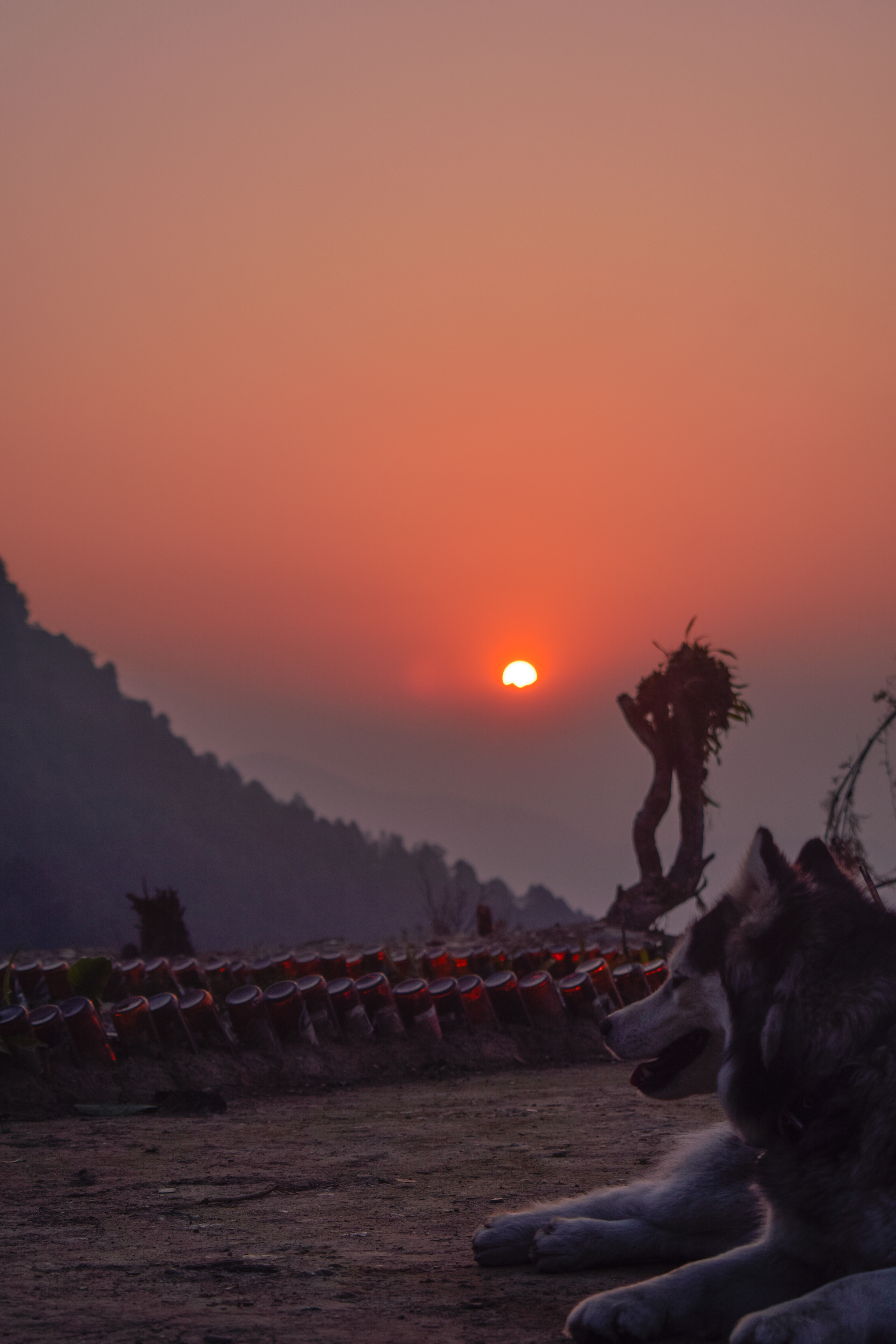
The second and third days of the trek are mostly through dense forest and river trails, with no clear views of the surroundings, which can be disappointing at the beginning, but it is the beauty of the Annapurna Trail.
After a regularly scheduled breakfast, you will begin the trek through the small marketplace of the Sinuwa. The trail mostly follows Modi Khola and passes camps like Bamboo with occasional uphills and downhills, but the trails are more beginner-friendly except for the slippery stones when hiking downhill. For trekkers' spirit, nature also provides golden berries, which are commonly found on trails after Sinuwa. Lunch is provided in Bamboo or Himalaya, depending on the trekking pace.
Once you cross the Himalayas, the scene drastically changes as the forests vanish in their quietness and become more open. The trails shift from a dense forest river trail to a glacier trail near Deurali, which is a small lodging place between giant peaks.
In Deurali, there is a mystery passed among guides and trekkers alike that Buddha blesses every trekker who is heading towards Annapurna Base Camp. The belief started with a mysterious stone Buddha figure on one of the peaks near Deurali, on the right-hand side when heading north.
Leaving the mystery behind, the trail now changes from a gloomy forest to an alpine glacier river trail. Crossing the Modi River, you trek upstream until you reach another steel bridge connecting the two sides. After an hour of river trail, you follow the stream until you can see Mt. Fishtail on the right side and Hinchuli on the left. The Machhapuchre Base Camp lies below the Annapurna Base Camp, since the two giant mountains sit directly opposite each other, protecting the glacier valley and ancestral pasturelands. The Annapurna Base Camp is another hour of hiking from MBC, and the arrival at the base camp is marked by a small glacier pond near the base camp board filled with prayer flags, dreams, and achievements.
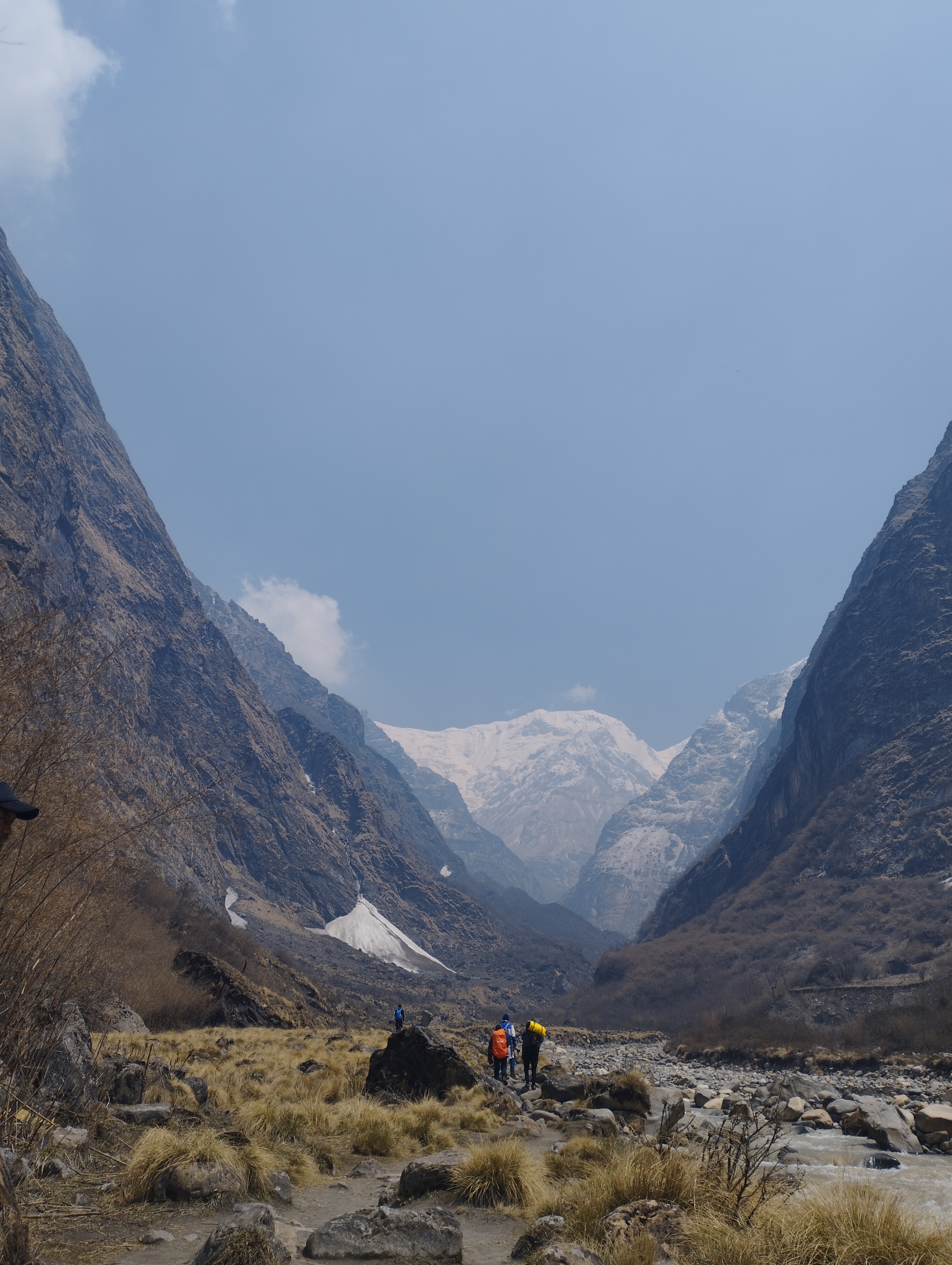
With the last view of the Machhapuchre and Annapurna, the trek retraces the same trail through the glacier ponds and rivers. Lunches are provided en route, and with a last close glimpse of the Himalayas, you once again enter the dense forests of the Annapurna region and trek towards Bamboo, where you initially stopped for the lunch break.
Today's camp is in Bamboo, which is a small lodge settlement hidden in bamboo forests, quiet, calm, and peaceful for resting.
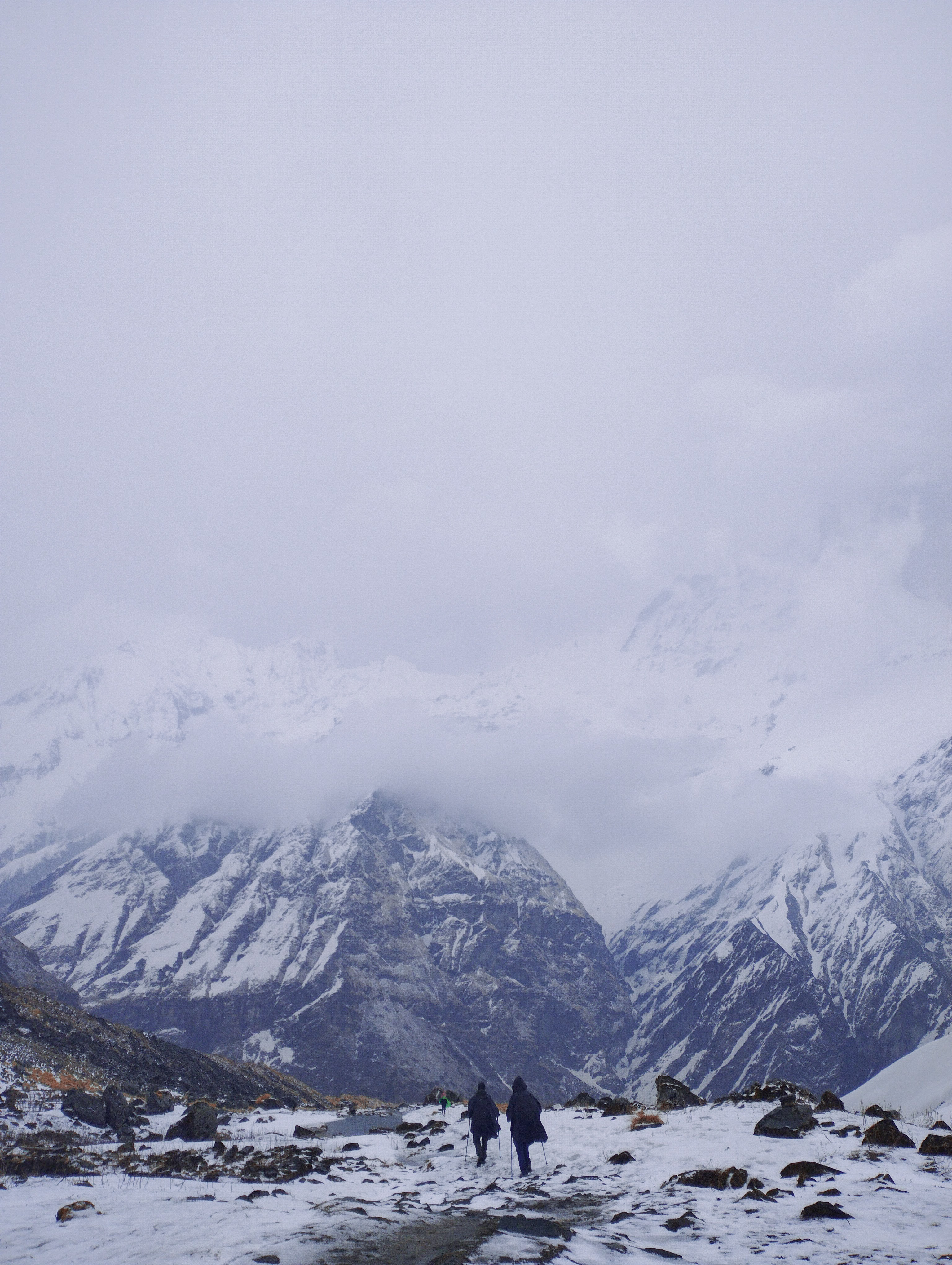
Retracing the trail from Bamboo to Chhomrong, the trail takes a drastic turn after checking out of Chhomrong Village. Following the same river trail can be boring, and taking a direct jeep is also not worth it. So, instead of following the regular trails, the trek shifts from the river valley to the hillside with a constant downhill via the Chhomrong Pass.
After an hour of downhill, the trail crosses the Kimrong River in the Kimrong Valley and shifts uphill constantly till Komrong Danda, which is about an hour or two. Since the trail is a bit difficult, lunches are provided at Chhomrong. Once Komrong Danda is crossed, you will trek on roads and off the road for another hour or two till we reach the beautiful Gurung village, Ghandruk.
At an altitude of 1940 meters above sea level, Ghandruk village is a peak tourism destination and resting place for both the Annapurna Base Camp and Ghodepani Poon Hill treks. With a panoramic view of the Annapurna Range, Machhapuchre, and Mardi Himal, the village is known for both scenic natural scenery and tiled-roof villages.
The last day of the trek can be ended with a short hike or a direct drive from Ghandruk to Pokhara. The hike lasts for an hour to a small village or resting place known as Siwai, from where it’s a 2-3 hour ride downhill off-road to Syauli Bazar. Crossing Syauli Bazar, it reaches Birethanthi, which is another checking point to the Ghodepani Poon Hill Trek; after that, the road heads from Nayapul to Kande and follows the same route from Phedi to Pokhara through towns and markets. The trek ends after a farewell with guides and porters once you’re dropped to your hotel.
This 7-Day Annapurna Base Camp itinerary is a short version and good only for trekkers, so we always suggest you to allow a few spare days if you need enough time to make it smoothly. Fast ascend may cause acute mountain sickness, and it is always good to have some buffer days while trekking Himalaya in Nepal so you can trek with peace of mind.
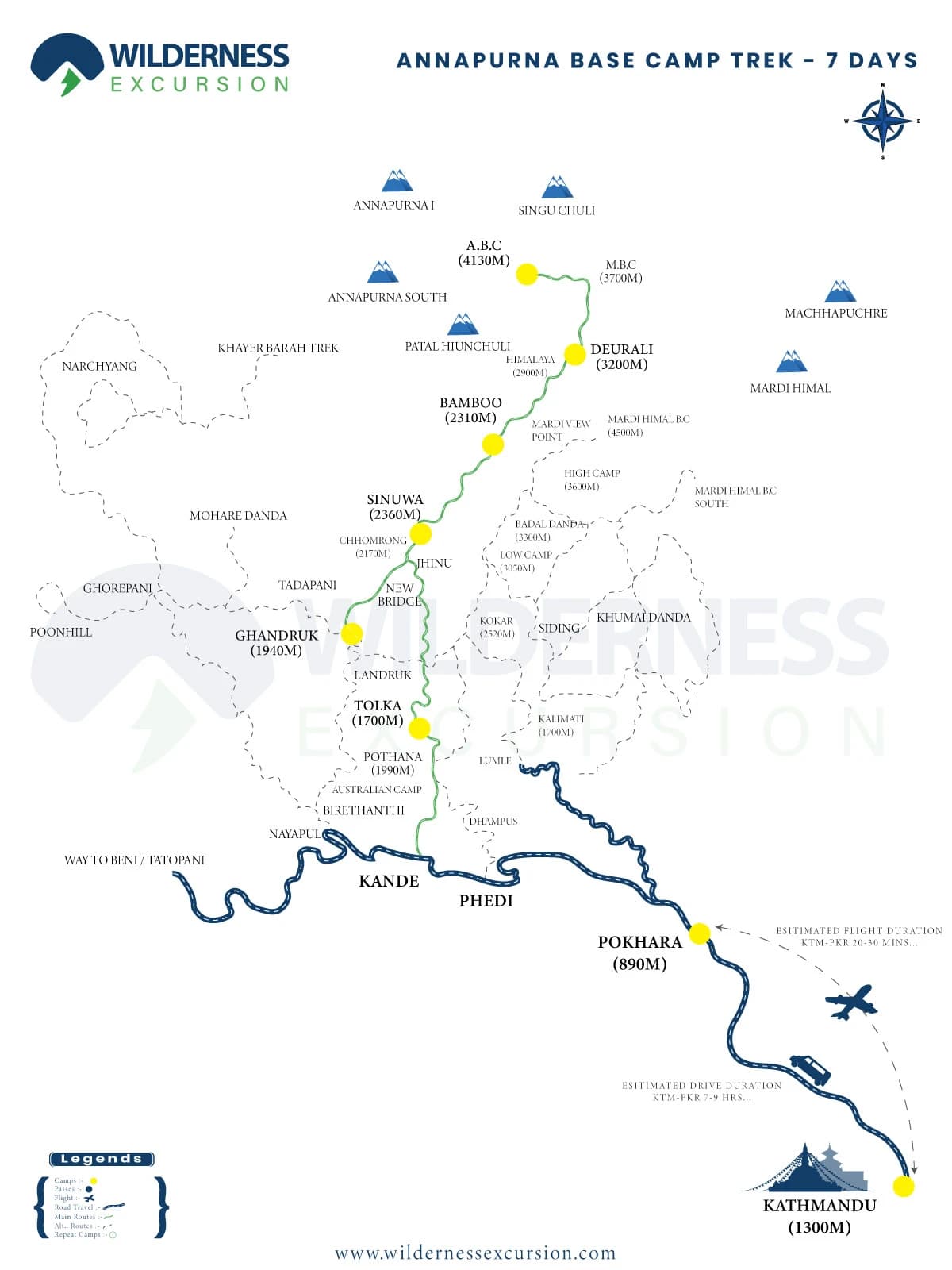
Route Map
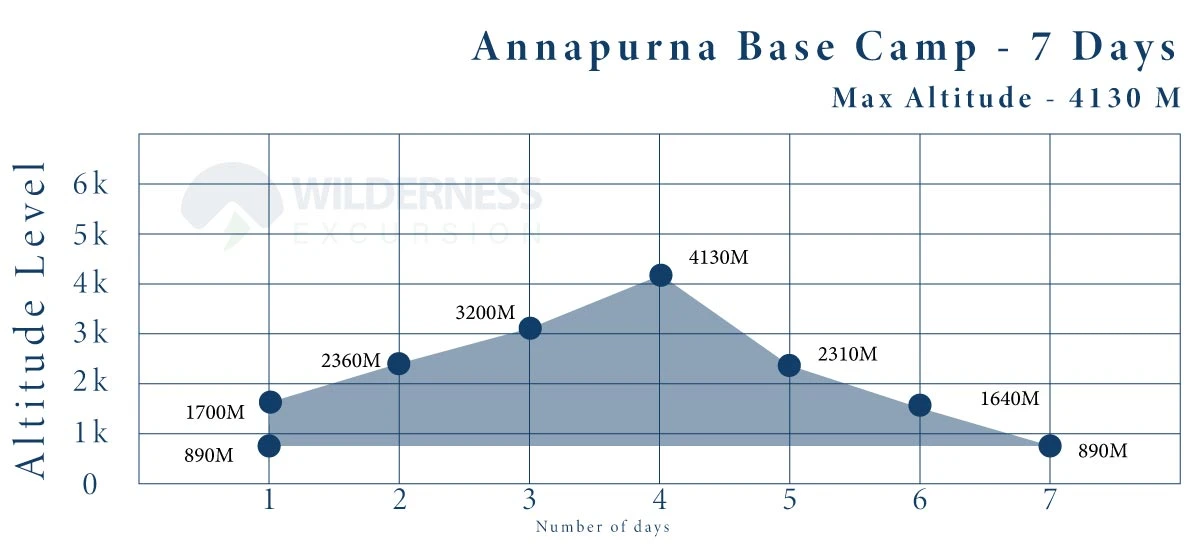
Altitude Chart
Still Confuse?
Download brochure or customize your trip.
Cost Details
Includes
- An experienced local trekking guide for Annapurna Base Camp.
- Meals: 6 breakfasts, 7 lunches, and 6 dinners with one main course of meal.
- Transfers to and from trekking to your hotel in Pokhara.
- Trekking lodge accommodation during the trek on a twin/triple sharing basis.
- Guide fee and all his/her expenses during the Annapurna BC trek.
- Annapurna Base Camp trekking permits.
- Insurance and trekking gear for your support staff.
- Local taxes and documentation fees.
- Emergency rescue arrangement coordination.
Excludes
- Accommodation and meals in Kathmandu and Pokhara.
- All surface transportation between Kathmandu and Pokhara.
- Guided sightseeing and monument entrance fees in Kathmandu and Pokhara.
- Hot and cold drinks (tea, coffee, and beverages)
- Bar or alcoholic drinks during the journey.
- Personal insurance, laundry service, and trekking gear.
- Trekking porter (it will cost an extra USD 140 per porter).
- Rescue operation charge in case of emergency.
- Tips for your guide and porter (recommended).
Add-ons & Options
At Wilderness Excursions, we have 14 years of excellent operation and decades of expertise in leading treks in Nepal. To further enhance your Annapurna Base Camp Trek, we’re pleased to introduce exclusive add-ons for an even more exceptional adventure.
- Kathmandu - Pokhara flight ticket USD 125: If you would like to take a 25-minute scenic flight from Kathmandu to Pokhara, that will cost USD 99 per person with airport transfers.
- Pokhara - Kathmandu flight ticket USD 125: If you would like to take an air travel after the trek to get back to Kathmandu, it will cost USD 100 per adult with airport transfer.
- Accommodation Booking in Pokhara USD 45: Pre- and post-ABC Trek deluxe room booking in Pokhara in a 3-star category hotel centrally located at Lakeside for double occupancy basis with breakfast will cost USD 45 a night.
- Single Room Accommodation Booking in Pokhara USD 35: A single deluxe room with breakfast is USD 35 a night in Lakeside for pre- and post-7-day ABC Trek.
- Porter Service USD 140: If you would like to hire a porter to carry your main pack, it will cost USD 140 shared between two trekkers.
Dates & Availability
Select Departure Dates
Oct 2026
Nov 2026
Dec 2026
Check our published date! If it doesn’t match, we will be happy to customize your tour perfectly to suit your interests and needs, creating a unique travel experience for you!
Essential Information
Things to know about the Annapurna Base Camp
Important notes for the Annapurna Base Camp
- Trekking difficulty: Nepal is a paradise for trekkers. The hidden valleys of the hills, the high passes of the Himalayas, and the flat region of Terai offer varying degrees of intensity. A trek's difficulty is measured based on multiple factors. Such as altitude level, walking days, rest days, and the sum of uphills and downhills. For a moderate trek like Annapurna Base Camp at an altitude of 4190 m above sea level, with a walking day of 7, it can be marked as a beginner-friendly trek. Why?
Unlike a circuit or round trek, where you start from one point, pass through high altitudes, and cross to a different region. Annapurna Base Camp is a simple trek, where you reach the destination and trace back on the same trail. The trails mostly pass through dense forest in the lower regions and, after a certain distance, walk along the Modi River till the Machhapuchhre Base Camp. In accordance with our standard itinerary, only two areas have continuous uphill for hours: from the New Bridge to Chhommrong and from the Modi River to MBC. With an average of 6-7 walking hours, Annapurna Base Camp is the perfect choice for beginners and all ages.
- Best time to trek: Nepal is one of the few countries where traveling on foot is more popular than using any modern transportation. Travelers start their journey from the lower regions, gradually ascend to the high passes, and eventually descend to the lower valleys. Such a practice of traveling is one of the common methods of trekking, depending on the nature of the trek. Trekking is an adventure where reaching the destination isn’t the only priority, but exploring the valleys, which includes both natural scenery and indigenous culture, is. Many factors, such as the nature of the trek, weather, altitude level, and number of walking days, determine which season is best for the trek. For a moderate trek like Annapurna Base Camp, the widely preferred trekking season is the best possible choice. Currently, two seasons are considered the best time for doing any adventure in Nepal. The months from March to June and from September to late December.
Spring season (March-May) – Pre-monsoon
-
- Warm days and less rainfall make trekking pleasant.
- Trails are colorful with vibrant rhododendron forests.
- Less haze makes the Himalayan peaks visible.
- Festivals like Holi fall around the same time.
- Active Himalayan wildlife makes it easy to spot during the trek.
Autumn season (September-November) – Post-monsoon
-
- Crystal clear skies after rain make peaks exceptionally photogenic.
- Dry season with minimal rain, ideal for long treks.
- Warm days and cold nights.
- Major festivals of Nepal: Dashain and Tihar fall around the same time.
- Locals celebrating the harvest season in villages.
Foreign and local trekkers alike choose trekking seasons based on what suits them best. Both seasons have perks, so your travel plan plays a vital role. What do you expect from the trek, what do you want to experience, and what are the holiday durations?
- ATMs, Banks, & Money Exchanges: After crossing Pokhara, once the trek officially starts, you won’t find any ATMs, banks, or money exchanges. Although locals may offer help in exchanging currency, most would charge extreme fees. So, always carry local currency after exchanging it in Kathmandu or Pokhara. Always exchange with authorized dealers at fair prices. Exchange rates are mostly provided by the dealer and will charge fees depending on the exchange value.
- Hot showers: Unlike hotels in towns, which use solar power for hot showers, lodges depend on LPG gases for hot showers, and most lodges provide only bucket showers. And hot showers cost extra charges, which are not covered by the package. The most practical advice is to take showers when you’re at low altitudes. Taking daily showers at high altitudes can be prone to headaches and uncomfortable rest. For hygiene, you can use wet wipes for cleaning armpits and towels for sweat.
- Permits for the Annapurna Base Camp: Permits and any essential documentation are handled by the agencies. Before the departure, you will be kindly asked to submit a few pieces of paperwork to obtain the necessary permits. The charges required for the permits are also already covered by the package cost per person. But if you like to have more information on permits required for the Annapurna trek, we will discuss it in more detail below. For general information on the permits for the entire trek, follow the link.
- Travel Insurance: When traveling for weeks to unknown places, it should be habitual to have travel insurance for each person. The trail to Annapurna Base Camp is reputedly safe, but unexpected circumstances may require quick evacuation and rescue operations, and such services would cost enormous amounts. So, it is better to pay a small fee to insurance agencies rather than covering the whole cost later. The agencies provide multiple insurance coverage options, so choose the one depending on the need and travel duration.
Arrival and Visa process in Nepal (H3)
The Government of Nepal provides "on-arrival visa" services to travelers who are traveling with all the proper documents. So, you can apply for the visa once you arrive at Tribhuvan International Airport, which saves a lot of time. Under the Department of Immigration, you can either apply for an online visa or use the kiosk machines for applying for the visa.
Once the visa is applied for, there are other processes to verify your visa. The basic process is given below:
- Fill in the 'arrival card.'
- Fill in the online ‘Tourist Visa’ form. You can fill it out online before you arrive at the Department of Immigration or use the kiosk machines upon arrival at the airport.
- Make payment at the bank according to your visa requirement (15/30/90 Days)
- Get the receipt.
- Proceed to the immigration desk with your online form, payment receipts, and your passport.
- Hand in your documents to the immigration officer for visa processing.
(Immigration, 2026)
On Arrival Visa Fee Structure
15 Days – 30 USD
30 Days – 50 USD
90 Days – 125 USD
(Immigration, 2026)
Arrival in Nepal – What can you do?
All the flights to Nepal land at Tribhuvan International Airport, Kathmandu. So, once you land in Kathmandu, you will have two choices: either to fly directly to Pokhara from the domestic terminal or spend your day in Kathmandu. While both options are alluring, it is best to spend your first days in Kathmandu, meet with the agency and your trek staff, and enjoy the city's ancient history.
Kathmandu holds centuries-old history, some preserved in museums and palaces, while others still thrive in the temple streets. While you are in Kathmandu, you can visit these durbar squares or simply walk on a street filled with history and conserved traditions.
Pick-up & transportation in Kathmandu: In accordance with the itinerary, your trip officially begins in Pokhara, so the package cost won’t include any services before Pokhara. But if you require pick-up from the airport and drop-off after the trek, we would be delighted to arrange private transportation. The same goes for transportation from Kathmandu to Pokhara. So, if you plan to stay your first few days in Kathmandu, you would be responsible for arranging the tickets to Pokhara.
But why bear all this hassle when you can choose our additional services of flight and ground transportation options, integrated into the system itself? Choose a travel plan from the add-ons option and enjoy the trip while we arrange everything for you.
Hotel in Pokhara and Kathmandu: The room bookings are not provided, but they can be added to the itinerary. Our add-on options are limited to basic 3-star hotel rooms, which offer great views, a peaceful neighborhood, and market access, but if you’re looking for more deluxe or royal suites, they can be arranged during the booking process. Before booking and final payment, attach a note about the required services that are not available in the add-ons.
Trekking difficulty during the trek in the Annapurna Base Camp
The difficulty of the Annapurna Base Camp varies significantly depending on the starting point. The 7-day Annapurna Base Camp trek starts from Phedi, which can be challenging due to constant altitude gains and uphill trails in the beginning, but compared to the whole trail, it is a beginner-friendly trail since most of the trails are on riverbanks and hillsides.
Trails of the 7-day Annapurna Base Camp
Since our itinerary begins from Phedi, which is a small town approximately 900 meters above sea level, the trek begins with an uphill climb to Dhampus Village. From Dhampus Village, you would spend most of the time on the roadways till you reach the connecting trails of Mardi Himal to Pothana. From Pothana, it is mostly downhills on and off the trails following roads from Tolka till Landruk Village.
Now from Landruk Village, it is mostly on river valleys from where you cross suspension bridges and continue uphill to Jhinu Danda and continue the most extreme uphill trail of the trek to Chhomrong. Till this point, most of the uphill trails are done, with the last trail at Sinuwa. After the Sinuwa, the trail will follow the river flowing from base camp. The trails are mostly on glacier valleys and riversides with peaks on both sides.
Physical challenges and preparations for the trek
The trek difficulty is relatively easier, but even simple hikes require a level of fitness. For a week, you would be constantly walking on different trails and environments, and an untrained body faces multiple problems mainly due to built-up fatigue. The highest altitude during the whole trek is around 4130 meters above sea level, so you won’t require any extreme training or any technical equipment. But having basic fitness for endurance is important when you’re trekking anywhere. So, what can you do before the trek?
- First priority is building stamina with light jogs or walks.
- Build hiking experience in local peaks or hiking destinations.
- Maintain a proper sleep schedule and rest days for the body to recover.
- Maintain a proper diet for local foods available during the trek.
Common trekking challenges and solutions
To general knowledge, the altitude is the most challenging part of the trek, which is also true, but the human body can gradually adapt to these changing conditions. But there are some challenges that most trekkers do not realize before trekking, and these are the crucial part of successful trekking.
For instance, staying hydrated. Through experience, we have known that local water sources in the trekking trails do not suit foreign trekkers. The unfiltered water contains dust particles and microscopic beings, which can be harmful to trekkers and mostly lead to excessive diarrhea. In such situations, the practical solution is to use filtered and sealed water bottles sold in lodges and teahouses or use a water filter and filter tabs. Aside from water problems, food items provided in lodges do not meet the consumers' needs or taste, and most tend to avoid the food, which later continues to cause fatigue, low energy, lightheadedness, and possible altitude sickness symptoms.
Altitude sickness and remote remedies
Altitude sickness is a state where your body is not able to adapt to the changing environment or where your body is getting less oxygen from the air than it usually needs to function properly. When trekking the high-altitude regions, the air contains lower oxygen levels, and most bodies, which are used to low altitudes, need time to adapt to this new environment. The common symptoms of altitude sickness are fatigue, headache, nausea, vomiting, and tiredness. On the surface it may seem like a long travel duration, but if more than 2 symptoms are shown at the same time, it is best to stop trekking any higher.
The most practical solution that doesn’t involve medication or drugs for altitude sickness is to head towards a lower altitude. There are tablets like Diamox that are used by most trekkers for altitude as well, but the best precaution is trekking gradually, preserving stamina, and having enough rest. Remember “trek high but stay low," meaning even if you trek to a high altitude, always set your camp at a low altitude as much as possible.
Weather and seasonal conditions of the Annapurna Base Camp trail
The trails of the Annapurna Base Camp traverse hilly pasturelands, river valleys, forest trails, and glacier valleys. The conditions of these trails change depending on the season you’re trekking. Although most trekking seasons fall before rainy seasons and winter for the best experience, weather can get tricky in the hills and Himalayas.
In the spring season (March-May), you experience occasional rainfalls, which make trails slippery in the lower parts of the trek, especially near Landruk and trails between Chhomrong and Bamboo, since these parts are mostly covered by dense forests. But the rain can be a blessing in disguise; the drifting cloud in the Himalayas gets cleared after heavy rain, unveiling the whole beauty of the Annapurna.
From September to November is the season of fall (autumn season); the trails shine with golden color due to withering leaves and the coming of winter. With festivals all around the region, the trails are mostly dry and safe with crystal-clear views. Even the snowy landscape of the Annapurna Base Camp reveals the high pasturelands, where once countless lives depended.
Accommodation standards at different points of the Annapurna Base Camp
There are multiple variations of the Annapurna Base Camp due to road access at different points of the trail. But this also contributes to providing better service to trekkers; although most camps follow a similar pattern, depending on the region and distance from the nearest town, it varies. So, let’s compare the different accommodations in different points of the trail that are connected to the road and those that are the true remote trails.
The first and second days of the trek, in accordance with the itinerary, Tolka and Sinuwa are the only camps that have road access. Although Sinuwa is a few hours of walking, the distance is still close to the road. So, during these days, accommodation is really peaceful meaning although every lodge has two beds per room as a sharing basis, you will have plenty of choices for room and distances between the rooms for privacy and attached bathrooms
The rest of the days from Deurali till base camp and back are the only camps that are farther from roads. Despite such difficulties, the lodges around these places still follow the standard room-sharing basis for comfortable rest and stay. The rooms will be really basic with beds and probably a drawer, with shared restrooms.
Once you trek back to Ghandruk, it is actually the best and popular tourist destination even among the locals. With the growing popularity of the place and rapid development, Ghandruk houses some of the finest lodges, hotels, and resorts as well. During your stay in Ghandruk, you can expect similar facilities in Kathmandu or Pokhara with attached bathrooms and views of the Himalayas from your very rooms.
Common food items and sets during the Annapurna Base Camp
Food items are actually similar throughout the trek, except for Chhomrong, where menus are similar to those of 3-star restaurants with a variety of options. Since Chhomrong is a village that later focused primarily on trekking and tourism, the place has some fine hotels and restaurants as well.
|
Menus |
Items |
|
Breakfast sets |
Tibetan Bread / Chapati with Honey / Jam, Fried potatoes, sandwiches, White bread with Jam / honey, and vegetable soups |
|
Lunch Sets |
Nepali Khana Set, Veg Spring rolls, Momo, Fried Noodles, Soups, Thukpa |
|
Dinner Sets |
Same as Lunch |
|
Drinks |
Black tea, Black coffee, Tibetan tea, Hot Chocolate, Hot milk, |
Permits and entry requirements for the Annapurna Base Camp
The Annapurna Base Camp is protected and conserved by the Annapurna Conservation Area Project, with Chhomrong and Birethanthi serving as the checkpoints into the premises of the conservation. Trekkers are legally required to obtain the conservation permit issued by the Nepal Tourism Board. Individual trekkers are able to obtain the permit after submitting the application and necessary documentation from the respective bodies in Pokhara or Kathmandu. Trekkers who are booked through the agencies need to provide details of the passport and visa for the necessary documentation. To get conservation permits, there are strict requirements such as the following:
- A licensed and certified guide should accompany the whole trek.
- Valid passports should be provided when applying for the permits.
- Visa should cover the trek itineraries and return dates.
- Permits cannot be transferred to other trekkers.
The cost for the permits of different nationals and ages is given:
|
SN. |
National Parks/Wildlife Reserves/Conservation Areas |
Nepali |
SAARC |
Foreigners |
Child discount |
|
1 |
Annapurna Conservation Area |
NRs. 100 per person per entry |
NRs. 1,000 per person per entry |
NRs. 3,000 per person per entry |
Below 10 yrs free |
Source: (Board, 2026)
The given cost details apply to the ACAP, and costs can differ with each conservation and national park. For cost details on other conservation, national parks, and wildlife reserves, follow the link to: Updated trekking permit and fees.
How to get the ACAP permits?
To apply for the ACAP or any conservation permits, you can either visit the website and apply for the permits or visit the Nepal Tourism Board in Kathmandu or Pokhara and fill out the application form and pay the fees at the counter. For the online permits, visit the given link and fill out the form. Once the form is submitted, you will receive payment options, where you can either choose to pay online or visit the EP counter for cash payments.
Entry fee and payment options for the conservation permits
- The entry fee is NRs. 3,000 for foreigners and NRs. 1,000 for SAARC nationals (tax included).
- Two payment options are available: Online Payment and Counter Payment.
- If you choose online payment, you will receive your permit directly by email after successful payment, and visiting the EP Counter is not required.
- If you choose Counter Payment, you must visit the EP Counter and pay the permit fee in cash. Please bring your passport or any valid identification to collect your permit.
- For Online Payment, an additional 2.9% payment charge will apply
- Double fees will be charged for permits issued at Check-Posts.
Source: (NTNC, 2026)
Transportation and road access to the Annapurna Base Camp
Pokhara is the starting point or the gateway to the Annapurna Region, and there are two viable options: ground & flight. The flights are operated directly from the Tribhuvan International Airport, with an available cost of USD 125 per person per flight. The flight takes 20-25 minutes approximately after the time of takeoff. For ground transportation, there are multiple options for tourist buses, local buses, and microbuses. For comfort and safe journeys, the tourist bus is the foremost choice. For USD 35 per person, a comfortable sofa seat is provided for a 7/8-hour ride.
As we have mentioned, once the trail officially starts, there are multiple starting points and road access to the Annapurna Base Camp. Our standard itinerary starts from Phedi town, while you can also drive to Dhampus. Another starting point is Kande, which is right above the Phedi, so the trekking duration is the same. Whereas the last and closest starting point is the Jhinu Danda or New Bridge, which significantly shortens the itinerary. Following the route to Birethanthi, you can choose to drive to Jhinu Danda and start trekking right away.
Annapurna Base Camp variables and extendable routes
The Annapurna Base Camp is part of the greater Annapurna Region, where multiple short and popular destinations lie, all connected like a web. Globally known trekking destinations like Ghodepani, Poon Hill, Mardi Himal, and Ghandruk are all linked silently to each other. This lets trekkers customize their own trekking plans, symbolizing the freedom of traveling.
Annapurna and Mardi Himal Trek – 11 Day
Below the Machhapuchre Base Camp lies a locally known mountain, Mardi Himal (5587). The name “Himal” itself translates to "mountain," which was first summited by Basil Goodfellow in 1961 A.D. Prominently known for colorful forests of rhododendrons and the closest view of the Annapurna Range, the Mardi Himal Base Camp is popular for the alpine experience of the Himalayas. The trails highlight old pasture lands, villages, and seasonal pastoral shelters with views of the mountains along the trails.
Outline itinerary for the Annapurna and Mardi Himal Trek
|
Trek Day |
Itinerary |
Camp Altitude |
|
Day 01 |
Drive to Jhinu Danda from Pokhara and trek to Sinuwa (2360) |
2360 M |
|
Day 02 |
Trek to Himalaya (2900) from Sinuwa – 7/8 hrs |
2900 M |
|
Day 03 |
Trek to Machhapuchre Base Camp (3700) from the Himalayas. |
3700 M |
|
Day 04 |
Hike to ABC (4130) and trek to Bamboo (2310) |
2310 M |
|
Day 05 |
Trek to Landruk (1565) from Bamboo – 6/7 hrs |
1565 M |
|
Day 06 |
Trek to Forest camp (2600) from Bamboo – 6/7 hrs |
2600 M |
|
Day 07 |
Trek to Badal Danda (3300) from Forest Camp – 5/6 hrs |
3300 M |
|
Day 08 |
Trek to Mardi High Camp (3800) – 4/5 hrs |
3800 M |
|
Day 09 |
Hike to Mardi Base Camp (4500) and trek to Low Camp (3050) |
3050 M |
|
Day 10 |
Trek to Australian camp (2100) from Low Camp |
2100 M |
|
Day 11 |
Trek to Phedi and drive to Pokhara (890) |
890 M |
Annapurna Base Camp Via Poon Hill – 10 Day
The route following the Poon Hill trek to the Annapurna Base Camp features a gradual progression through hills and a Himalayan experience. Primarily known as a route for bird watching, colorful forests, and great panoramic views of the Annapurna Range, including Dhaulagiri, from Poon Hill, the itinerary combines the classic village-and-pasture-lands route. Originally, before the tourism settlement, local people used these trails as a means of traveling to Pokhara and other nearby towns and cities, whose existence is the stone-paved stairs and trails near small settlements and farmlands.
Outline itinerary of the Annapurna Base Camp via Poon Hill
|
Trek Day |
Itinerary |
Camp Altitude |
|
Day 01 |
Drive to Nayapul and Trek to Ulleri (1960) |
1960 M |
|
Day 02 |
Trek to Ghodepani Deurali (2880) |
2880 M |
|
Day 03 |
Hike to Poon Hill (3200) and Trek to Tadapani (2630) |
2630 M |
|
Day 04 |
Trek to Chhomrong (2170) from Tadapani |
2170 M |
|
Day 05 |
Trek to Dovan (2600) from Chhomrong |
2600 M |
|
Day 06 |
Trek to Deurali (3200) from Dovan |
3200 M |
|
Day 07 |
Trek to Annapurna Base Camp (4130) |
4130 M |
|
Day 08 |
Trek to Bamboo (2310) via MBC (3700) |
2310 M |
|
Day 09 |
Trek to Jhinu Danda (1580) from Bamboo |
1580 M |
|
Day 10 |
Trek to Siwai and drive to Pokhara (890) |
890 M |
5 days Annapurna Base Camp – Short and comfortable
The 5-day Annapurna Base Camp trek is carefully planned for experienced trekkers who are looking for short and thrilling adventures and want to experience the Annapurna Base Camp in limited time. The itinerary is trimmed with a direct jeep ride to Jhinu Danda and returns the same route to minimize cost, time, and efficiency.
Outline itinerary of the Annapurna Base Camp – 5 days
|
Trek Day |
Itinerary |
Camp Altitude |
|
Day 01 |
Drive to Jhinu Danda from Pokhara and Trek to Sinuwa (2360) |
2360 M |
|
Day 02 |
Trek to Himalaya (2900) from Sinuwa |
2900 M |
|
Day 03 |
Trek to MBC (3700) from Himalaya |
3700 M |
|
Day 04 |
Hike to ABC (4130) and trek to Bamboo (2310) |
4130 M |
|
Day 05 |
Trek to Jhinu Danda and drive to Pokhara (890) |
890 M |
Annapurna Base Camp Trek - 7 Days FAQs
The standard old itinerary of the Annapurna Base Camp lasts for a week starting from Kande or Phedi. Other variations of the trek include a 5-day trek option, which starts directly from Jhinu Danda with a jeep ride of more than half of the original itinerary.
The base camp altitude is 4130 meters above sea level, which is the highest point you will reach in accordance with the itinerary.
The 7-day Annapurna Base Camp starts from a lower altitude in a river valley for better acclimatization, while the 5-day itinerary is focused on shorter and hyper-pacing.
The Annapurna Base Camp offers three steps of scenery, from the river and dense forests to glacier rock spire trails and the great Himalayas' 360-degree scene.
Although Annapurna Base Camp is primarily known for being beginner-friendly, it is better to have prior trekking experience or at least a hiking experience at an altitude of over 3000 meters.
Well, this is a short version of the Annapurna Base Camp trek. The usual and traditional Annapurna Base Camp trek is 10 days long via Poon Hill. The Annapurna Base Camp Trek route covers around 125 km, and you will be walking 10 to 18 km each day. This trail is a popular one and is usually packed with trekkers from all over the world. The trekking trails are easier on this trek.
The trails are beginner-friendly, but the trek still reaches above 4000 meters altitude, where chances of altitude sickness are high. So, a proper fitness and hiking experience is highly advised before trekking.
Both the Government of Nepal and TAAN suggest hiring a trekking guide even if you do not trek from an agency. A guide is more than a walking map and is important for well-being and safety during the trek.
An authorized agency is legally required to submit guide insurance and license details, so guides hired from the agency are licensed, trained, and well-insured.
The filed staffs such as trek guides, porters, porter guides, and any assistant guides, are properly trained under a government institution and well-insured before any departures.
Unfortunately, no trekkers are allowed to trek any regions of Nepal alone. Since obtaining the permits, the trekkers are required to hire a guide and fill out the guide details as well.
Arranging the permits by yourself is possible, as we have mentioned above. You can either visit the official website of NTNC and apply for the permits or visit the office in Bhrikutimandap.
Booking the Annapurna Base Camp with Wilderness Excursion is simple and user-friendly. In a few steps, you can book your trip with Wilderness Excursion without any hassles. Simply follow these basic steps:
- Click “Book this trip” on the left-hand side of the screen.
- Fill out the booking form and the additional services required.
- Proceed to payment and book the trip with a 15% advance.
Our terms and conditions for cancellation vary depending on the scenarios, such as the date of booking and departure, the cause of cancellation, and many more. Please follow the given link to view our cancellation policy.
Yes, you may reschedule your trek if the necessary preparation for the trek hasn’t been made and departure is still due. No additional charges are required in such cases.
Yes, a 15% advance of the total booking cost is required as a deposit for booking the trek with Wilderness Excursion.
In cases of emergencies, our team will immediately contact you and proceed with cancellation while reviewing the cause.
The 7-day package includes all the necessary basic needs for trekking, such as permits, documentation, basic 3 times meals, a guide and his/her expenses, and basic transportation to and from the trek.
The package cost won’t cover personal expenses such as bar bills and extra drinks. Any costs incurred due to self-requirement are to be covered by the trekkers themselves.
It is practical to separate Nrs 1000 per day as an additional expense for the trek per person. So, 7000 Nepali rupees should suffice a person.
The Annapurna trek houses mixed accommodations with lodges and teahouses in upper regions and basic hotels in village areas like Chhomrong and Ghandruk.
Yes, the 7-day package includes 3 meals—breakfast, lunch, and dinner—and complimentary services of fresh fruits and teas.
The lodges and teahouses mostly serve basic sets, which are quick to make, and ingredients can be stored for a long time. Mostly lodges serve breakfast sets of bread and jams in the morning or muesli and Nepali khana set, fried noodles, momo, soups, and rolls for lunch and dinner.
Yes, lodges and teahouses, as well as trail markets, sell sealed filtered mineral water for trekkers, but the price gets high as you trek higher.
Hotels in Kathmandu and Pokhara have options for storage to keep extra luggage safe while you’re trekking, but if you are uncomfortable with a hotel, we can also arrange to keep the luggage free of charge.
The maximum weight limit for a porter is 20- 25 kg, including their own weight. So, pack wisely and only take what you need during the trek.
The practical solution for handling altitude sickness is to trek to lower altitudes for better body function.
Yes, heli rescues are possible from Machhapuchre Base Camp in cases of emergencies.
Unfortunately, we do not provide first aid and medical kits to each trekker. You are responsible for packing your own, so carry basic medicines and health tools and Diamox for altitude sickness.
The Annapurna Base Camp is supervised by the NTNC under ACAP laws, and the trail is safe since locals are accustomed to foreigners, and the trail is mostly busy during peak seasons.
Before trekking, it is better to trek gradually and maintain rest and diet for a comfortable and safe trek.
Before the departure, we suggest having a basic fitness and endurance preparation with light jogs and hiking habits.
Having a basic fitness, stamina, and endurance capacity is enough to trek above 4000 meters easily.
To trek Annapurna Base Camp, quality trekking shoes and hiking outfits should be enough for the day hikes. But during heavy snows, crampons might be necessary, which we will recommend after checking the situation.
Yes, travel insurance is a must when trekking any parts of Nepal, and a copy of the insurance is to be left with the agency in case of emergencies or rescues.
The Ghandruk and Chhomrong villages are settlements mixed with primarily Gurung and Magar communities.
There are multiple cultural practices in Nepal, but the most basic is Namaste, which means hello, so it is customary to reply with a Namaste.
Yes, you may interact with local villagers if they consent. But in cases of rituals and cultural practices, it is important to ask for permission and consult with the guide.
The locals mainly depend on farming and animal husbandry, but with the growing tourism industry, the villagers also depend on foreign income through shops, hotels, and small markets.
Lodges may provide hot showers at extra charges, but hot showers depend on a gas cylinder to warm the water, which can be risky, and regular showers are also no reccommended once you're in high altitude.
The seasonal period from March to June and September to November is the best for trekking to Annapurna Base Camp. Both seasons are known for stable weather, scenic views, and safe trails.
This trek is considered moderate in difficulty. It involves some steep ascents and descents but doesn't require technical climbing skills. Basic fitness and prior trekking experience are recommended.
The Annapurna region is protected under the Annapurna Conservation Area Project; trekkers are legally required to obtain the ACAP permits from the Nepal Tourism Board.
Yes, there are mobile networks until Deurali. There is no network At Machhapuchhre Base Camp and Annapurna Base Camp, most of the lodges have Wi-Fi internet. Not fast internet but good enough to leave a message at least.
Yes, the trek itinerary is flexible and can be extended with trekkers' personal choices. Around the Annapurna Base Camp lie other popular trekking destinations like the Mardi Himal trek and the Poon Hill trek, which can be joined with the given itinerary.
What Our Clients are Saying?
based on 6 reviews
Annapurna Base Camp Trek - Great Experience!
This was, without a doubt, our most amazing experience ever! A huge thank you to our incredible porter, Ram, and our guide, Ajaya, for taking such great care of us and ensuring we had an unforgettable journey. I am so...

Audey Calmon- France
February 14, 2026The Joy of Reaching Annapurna Base Camp
My longtime dream of trekking to the Himalayas became a breathtaking reality.
I recently returned from the Annapurna Base Camp trek, and I am still riding the wave of awe from the experience. From start to finish, it was an...
Ji-woo- South Korea
November 20, 2025Annapurna Base Camp Trek – A Journey to Remember!
The trek to Annapurna Base Camp was an incredible experience! Our guide was highly experienced and took excellent care of us throughout the journey. The guesthouses provided hearty, delicious meals that kept us energized every day. Thanks to the company’s...

Py C- Malaysia
March 23, 2025Adventures Tailored for You


Need Help? Call Us+977 9851042153